All Saints’, Dorval
Proper 24, Year A
September 13, 2026
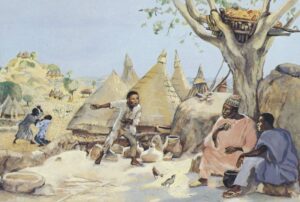
Jesus MAFA, “The Unforgiving Servant”
And in anger his lord handed him over to be tortured until he would pay his entire debt. So my heavenly Father will also do to every one of you, if you do not forgive your brother or sister from your heart.
Oof.
Jesus is asking us not just to forgive, not even just to do so over and over again, but to forgive from our hearts.
I can handle the rest of it – maybe – but this might just be the final straw. (I mean, assuming that, as Jesus seems to intend, the hearer of this parable is to be identified with the slave who started out owing the ten thousand talents. If instead we identify with the slave who owed him the hundred denarii, the story might come as uncomplicated good news!)
Ten thousand talents was a lot. The commentators appear to be a little confused about exactly how much – I’ve seen estimates ranging from $2 million to $60 billion – but they agree that it’s an impossible amount. This debt – even if the landowner had been letting it slide for years – would have hung like the sword of Damocles over the debtor and his whole family.
And then suddenly it was gone. Can you imagine the joy and the relief?
And yet – according to the story at least – instead of going on his way rejoicing, the former debtor has barely gotten out of the room before he runs across a fellow slave who owes him a couple of months’ wages, pounces on him like a terrier on a rat, and shakes him in the hope that a few extra coins will fall out of his pockets. Not cool, dude.
And yet, if you squint you can kind of see how it all feels like a little bit much. As huge as the relief is, the guy hasn’t had any time to get used to his new status. He got infinitely more than he expected, but he hasn’t caught up with the new expectations that being forgiven has placed on him. And let’s remember that he’s still not, or at least he doesn’t feel, rich – he’s just been dug out of a deep hole, but he’s not sitting on top of a pile of wealth. It’s perhaps understandable – if still problematic – that he kind of loses his head.
Now translate that into the terms in which the parable is inviting us to see this situation – that is, of us, and God, and our neighbour.
As we’ven noted, in the standard interpretation, God is the master, we’re the hugely indebted slave, and our neighbour is the slave who owes us a little bit. There are other ways to read this parable – there are always other ways to read a parable – but this is the one we’re going to run with, for now.
And if we look at it this way, we owe God everything. In the words of the old prayer of General Thanksgiving, we are in debt to God for “our creation, preservation, and all the blessings of this life, but above all for your immeasurable love in the redemption of the world through our Lord Jesus Christ: for the means of grace, and for the hope of glory.”
It is because God chose to create us that we exist at all; it is because God chose to become human that we have been rescued from sin and death after choosing our own selfish desires over God’s will for us. All of it – all the hope and love and beauty and safety and joy we will ever experience, and the promise of new life on the far side of death – comes from God.
As Paul says in the letter to the Romans, “so then, whether we live or whether we die, we are the Lord’s. For to this end Christ died and lived again, so that he might be Lord of both the dead and the living.” Death does not put an end to the gift of being God’s children; it is eternal.
But it’s so easy to take all that for granted – as the ungrateful slave takes the forgiveness of his massive debt for granted – and turn on those who make our earthly journey more difficult, even if their impact is negligible compared to the original gift.
As always when we talk about forgiveness, the necessary caveat: that forgiveness does not mean being a doormat; that boundaries are not just permissible, but essential; that true reconciliation requires that the person who has done harm frankly and fully acknowledge that harm, and genuinely change their behaviour.
But with all that said, what this parable invites us to do is to remember and live always in the consciousness that our debt to God – or as I might prefer to phrase it, our gift from God – is so enormous that all the ways that we hurt and fail each other shrink to almost nothing in comparison. Not nothing at all – the hundred-denarii debt is real, and so are the ways that your sister, or your coworker, or your ex-partner, or Elon Musk, hurt you. But if you have always in mind the tremendous gift that God gave you by creating you, saving you, and sustaining you in the first place, God will help you keep that hurt in its due proportion, rather than perpetuating it by grabbing that person by the throat and demanding immediate payment.
(OK, I might make an exception for Elon Musk.)
And sometimes, as we see in the snippet from the story of Joseph that was the first reading, God is working mysteriously to bring help and healing out of the hurt and harm. What Joseph’s brothers did to him was genuinely horrific: they literally sold him into slavery and deceived their father for decades into thinking his favourite son was dead. But when they all encounter each other in Egypt, Joseph tells them: “Do not be afraid! Am I in the place of God? Even though you intended to do harm to me, God intended it for good.”
Am I in the place of God? No. None of us are. God is the one who has provided the blessing, and we are called to live in that blessing as a present, active reality, instead of letting it just become the unacknowledged background to our lives.
And if we really do that, if we really let the enormousness of what God has done for us be front and centre, it will change and transform our hearts. A heart that is full of the knowledge of God’s great goodness is a heart that can be broken, but will not be hardened against our neighbour, even if that neighbour owes us a debt.
And knowing that, we can hear the final words of today’s reading with peace and assurance, rather than guilt, despair and panic:
So my heavenly Father will also do to every one of you, if you do not forgive your brother or sister from your heart.
Let your heart be filled with awareness of all that God has given you. The rest will follow.
Amen.
Leave a Reply