All Saints’, Dorval
Proper 25, Year A
September 20, 2026
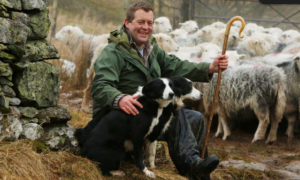
James Rebanks with his dogs and sheep
This past week, I was turning over the Parable of the Vineyard in my mind and wondering how to approach this incredibly rich text, which is one of my favourites and has a habit of popping up at pivotal times in my life. I happened also to be reading a book by the Cumbria shepherd, James Rebanks. The title, Pastoral Song, sounds like a description of church, but the book (published originally in the UK as English Pastoral) is actually about the farm that Rebanks’ family has stewarded in the Lake District since at least the fifteenth century. On the title page, the author has printed the dictionary definition of “pastoral”:
- Of or pertaining to shepherds; hence, relating to rural life and scenes.
- Relating to the care of souls.
And of course the connection between the two definitions is rooted in Jesus’ persistent use of farming metaphors, especially regarding sheep, as a way of illustrating his teachings about God.
In today’s passage, Jesus describes a scene that is startlingly familiar to us, two thousand years later: a large landowner picking up day labourers to do agricultural work. These people have no ongoing connection to the vineyard; their only link to it is the daily wage that keeps them alive. So it’s understandable that when the workers who have sweated for twelve hours see the ones who have only worked for an hour get paid the full denarius, they start to hope that maybe they might be in for a windfall. And when they don’t get it, their disappointment is palpable.
James Rebanks’ book is the story of how he grew up on the small fell farm in the Lake District on which he still lives with his wife and four children. His childhood was spent following his father and grandfather around the farm as they worked: raising livestock – sheep, cows, pigs – and the feed that sustained them – hay, barley, turnips – in a system of skilled, labour-intensive, mixed, rotational agriculture that had underpinned the human life of this region for hundreds of years. Largely by trial and error, the farmers of the Lake District had figured out that diversity, animal manure, and cover crops could keep their land healthy and productive, and their lives were full of hard work, bad weather, and risk, but also meaning, joy, and beauty.
As Rebanks became an adult, though, all that was changing. Intensive industrial farming was coming to the Lake District. Hedges were destroyed, fields drenched in pesticides, cows bred so aggressively to produce more and more milk that their health broke down before they were five years old. The wildlife and songbirds of the region began to disappear, and more and more farmers went bankrupt, sold up, or in some cases died by suicide.
Part of the decline that Rebanks charts is the disappearance of the traditional northern English farm labourer. These were men who didn’t own or run the farm, but who often lived on-site and were just as invested in the health of the land and the success of the business as those who did. Rebanks lovingly describes one of them, John, who worked for his father and grandfather. John and his fellow “hired men” were extraordinarily skilled, they worked incredibly hard, they were in a very real way actually part of the family, and without them, the tremendously complex balance of tasks and pressures on a mixed rotational hill farm began to break down.
The people Jesus describes – like the people in the photo on the sermon slide today, or the Hispanic farm labourers who migrate to Quebec to work in our fields and dairy barns – are not John. They do not have his permanence or his dignity. They may have fine-tuned skills and a desire to use them, but they are not given the opportunity to use those skills in the stewardship of one piece of land across the generations, sensing and observing and learning to do things better; they are, frankly, abused and exploited. They show up, they work their twelve hours, they go home. There is no ongoing relationship, beyond the exchange of cash for menial labour.
This parable is usually interpreted to be about our heavenly reward: you don’t have to be first in line to get into heaven, Jesus will welcome everyone in, no matter how late they show up. And that reading of the story isn’t wrong! It’s central to the beloved homily of St. John Chrysostom that we read at the Great Vigil of Easter, and I’ve preached it before, with particular emphasis on how if the denarius represents our eternal reward, of course none of the all-day workers could get more and none of the latecomers could get less – because the reward is indivisible; new life is new life, you can’t be a little bit in heaven, you either are or you aren’t.
But today, as you’ve gathered, I want to talk about what it looks like if we take the agricultural labour part of this story seriously.
The first third of Pastoral Song is about James Rebanks’ childhood, and the second is about his dawning horror at watching his family’s way of life, and the landscape that sustains it, be destroyed before his eyes. And the third and final section is about his own conscious decision to do things differently: to step back from the pesticides and the monocultures and the huge machines, to reintroduce the cattle and pigs that had been sold off, to reclaim the old, labour-intensive, rotational style of cultivation, to reconstruct the hedgerows, to allow local conservation organizations to come onto his land and reroute the waterways, plant native species, and “rewild” the patches between the working fields so that the birds and bugs and small woodland creatures could make their homes there again.
And of course this means not only changing the practice of farming, but reknitting the community that makes it possible. You can’t run a farm this way alone. “The more I have shared and accepted help,” writes Rebanks, “the more our farm has become a community … there is always someone else here working, or learning, or helping us.”
Not only Rebanks’ wife, Helen, and their children, but ecologists, government officials, students and teachers from the local schools, neighbours, and a new generation of farm labourers who do things like build a fence in a bog keep the livestock out of the wild habitat. All of them, together, putting in the effort and receiving a reward that is definitely not monetary – the farm is sustained by paid work in other arenas – but far deeper: the reward of learning together, and watching a patch of land come alive again.
I look at the denarius that the landowner offers his workers in today’s Gospel, and how grumpy are those who have “borne the burden of the day and the scorching heat” and receive no bonus compared to those who worked for only an hour. And I wonder how different things would be if, instead of being told to “take what belongs to you and go,” they were invited to enter into what belongs to them and stay. If being a labourer in the vineyard, instead of being a cash transaction, were the way into a community. If the point was not just to grab the reward, but to find a new way of life.
It’s still the season of Creation, and I can’t help thinking that Jesus, who created the link between the two definitions of the word “pastoral” by his use of the images of shepherding and farming to interpret God to his hearers, would want us to go beyond the symbol of the denarius into the reality of community, into being workers with skill and commitment and joy in our work, into a life that nourishes God’s good creation and in which all take part, whether they have been there for an hour, for a day, or for all eternity.
Amen.
Leave a Reply