All Saints’, Dorval
June 28, 2026
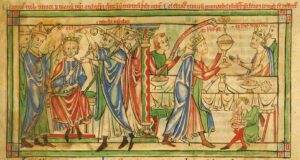
The hierarchies of the medieval world: the coronation of Henry the Young King in 1170 (illumination from BL Loan MS.88, c. 1230). Wikimedia Commons.
The words “righteous,” “righteousness” and “unrighteousness” appear a total of six times in today’s reading from Paul’s letter to the Romans, and three times in the Gospel reading – a passage that is only three verses long!
It’s a word that’s used a lot in the New Testament, and it’s a word that it’s easy to misconstrue in English translation.
The English word “righteousness” is a useful one that I would hate to let go of entirely, but it is increasingly becoming another piece of niche religious vocabulary, rather than a word that’s used in regular conversation. When it is heard outside a church context, it tends to have a negative connotation: it implies a rigid judgmentalism, or is used as part of the compound word “self-righteous”. (And this isn’t a brand-new development: I remember my mother remarking on it when I was a child!)
The Greek word usually translated “righteousness” is dikaiosyne, and I consulted a friend of mine who speaks modern Greek and was intrigued to learn that she would render it into English as justice or fairness.
So what did dikaiosyne mean to Paul and to the writer of Matthew, and how has that concept evolved over the last two thousand years of Christian history, and how would it be most helpful for us to understand it today?
This passage from the letter to the Romans concludes with the line, “For the wages of sin is death, but the free gift of God is eternal life in Christ Jesus our Lord.” The first part of that sentence is often quoted, but it’s actually the second part that is the point Paul wants to hammer home: he is more interested in celebrating the free gift of eternal life than in threatening people with death. But it’s important to keep both parts in mind.
Dikaiosyne, righteousness, justice, fairness – for Paul, this is what keeps the universe in order. God is righteous, and we participate in God’s righteousness through faith. The outward symbol of this participation is baptism, by which we become part of the body of Christ and thus are indissolubly connected with God. In this passage, Paul is exhorting the Christians at Rome not to think that their baptism gives them license to do all kinds of things that are inconsistent with the righteousness of God. Just because they are baptized doesn’t mean they can do whatever they want. If they are obedient to God, they cannot be slaves of sin, which is contrary to righteousness.
All that is just a paraphrase of what Paul says (and Paul can always say it better than I can). Where the rubber meets the road is what you think that righteousness (justice, fairness) is – what it looks like in practice – and hence, what it means that the wages of sin are death.
For Paul, it mostly meant believing in Jesus and the resurrection; not worshiping idols (and not behaving like a decadent idol-worshipping Roman); being in fellowship with people who were very different from you and respecting their consciences; being generous; and focusing on the imminent second coming of Jesus and the end of the world rather than on getting married, seeking advancement, or getting rich. For Paul, “the wages of sin are death” meant that anyone who missed the boat on these things was at risk of not actually rising to new life with Jesus when he came to initiate the new creation.
Like so many other things in Christian history, that changed drastically as generations passed and the second coming didn’t happen, and then as Christianity shifted from being an illegal fringe sect to being the official religion of the Roman Empire and then of Western Christendom. By the early Middle Ages, righteousness and justice had acquired a distinctly feudal flavour. Righteousness meant everyone staying in their place, with peasants subservient to lords and women to men. (This is of course an absolutely massive oversimplification, but I only have so many words for this sermon!)
Everyone (and least in theory) had their job: monks and nuns prayed, men grew food and fought battles, priests and scholars copied books and taught the Bible, and women stayed faithful to their husbands, had babies, and spun wool constantly so that everyone had clothes to wear. Individual preferences had as little to do with any of it as did any sense of greater social justice or inherent equality between people. Righteousness was maintained by maintaining society in the hierarchy that God had ordained.
Understanding this aspect of medieval thinking actually makes it a little bit easier, I think, to comprehend some of the harsher beliefs and practices of the day. Medieval people genuinely thought that illegitimacy, the existence of non-Christian people, and peasants who got ideas above their station (just to name a few examples), were displeasing to God and threatened the integrity of society itself. That doesn’t mean they were right, but it makes it easier to understand why they got so worked up sometimes; in their understanding, everyone behaving righteously – appropriately to their station – was literally what held the world together and ensured that salvation was possible. Unfortunately, they all too frequently interpreted “the wages of sin are death” to mean that the powers that be should not only determine guilt and pronounce the sentence, but carry out the execution.
For the last five hundred years or so, though, we’ve been groping our way to a new understanding of what righteousness and justice are. Not the life of a radical sect in momentary expectation of the Saviour’s return; not a hierarchy that marries church and state; but something more like Jesus’ vision of the leaven in the loaf, of belief in God and the resurrection as the motivation and inspiration for seeking justice and human dignity, indeed, human flourishing, for everyone in the world, whether they’re a fellow believer or not.
In this formulation, each of us is free to find our own relationship with God and to choose how we engage with our community. But we are always looking to welcome God, in Jesus, in the prophets, in the righteous person. Each of us has our part to play, even if it is only offering a cup of cold water to a child.
And each of us has a duty to be aware of – as the baptism liturgy puts it – “the sinful powers of this world that corrupt and destroy the creatures of God”.
Paul would recognize some of those powers. He would recognize the pressure and temptation to get rich, to wield earthly authority, to tell others what to do, to pass the time in meaningless pleasure rather than in doing something that nourishes one’s soul or helps others. He might not know what capitalism or climate change or transphobia are, but he’d certainly understand the feeling of being captive to malign forces larger than ourselves. (Just wait until you hear next week’s reading from Romans.)
In this understanding, “the wages of sin is death” is a simple statement of fact – that the destructions of late capitalism and climate change and transphobia and all the other -isms and –phobias and all the other ways humans find to hurt each other, are part of a system of death that is opposed to God. But remember, it’s the second half of the sentence that is more important: “the free gift of God is eternal life in Jesus Christ our Lord.”
Two thousand years on from Paul, we may or may not decide to put our energy into actually reclaiming the word “righteousness.” But we can be assured of what it means. Dikaiosyne, righteousness, justice, consists not of just trying to keep ourselves clean until Jesus comes back, nor of upholding an earthly hierarchy; but of opposing those malign forces with all our might, and putting our faith in Jesus Christ to give us new life, both here and now, and in the world to come.
Amen.