All Saints’, Dorval
September 6, 2026
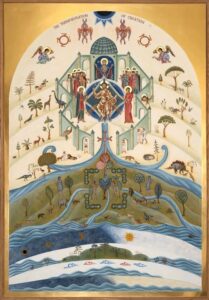
Aidan Hart, “Creation to Jerusalem” icon
Happy New Year!
If you’ve been around the Anglican Church – or any Western liturgical church, for that matter – for any length of time, you would expect to hear that said from the pulpit on the first Sunday of Advent, which this year is November 29.
In the culture of North America in 2026, though, right now feels far more like a New Year than any other time of year (a great deal more so than that random day a week after Christmas when for some reason we’ve decided it’s a good idea to stay out till midnight wearing uncomfortable outfits and drinking champagne).
In the first week of September, the kids are going back to school. People are returning from weeks away in their campers or at their cottages. All kinds of things are starting up again after their summer break. To acknowledge the way in which the school year still exerts such influence on everything else, even for people who haven’t been in school for decades, we’ve coined the term “program year” to describe this phenomenon
In the Church, it’s also the beginning of the Season of Creation, a new liturgical observance that lasts from the first Sunday in September until the feast of St. Francis of Assisi, five weeks later. This observance began in the Eastern Orthodox churches and has been gradually adopted in other Christian traditions over the last several decades. But what I did not realize until just this week is that in the Eastern Orthodox churches, not only do they celebrate the Season of Creation, it’s actually the beginning of their liturgical year.
Hence, my greeting at the beginning of this sermon.
And while I’m not sure I’m prepared to give up Advent as the beginning of our year, starting the year on this Sunday not only would align the church with the way the calendar actually, de facto, works in our society, but also makes a certain amount of intuitive sense on purely theological and liturgical grounds.
At General Synod last summer, the Anglican Church of Canada, having adopted the Season of Creation a few years ago, voted to formally adopt this particular Sunday as the Feast of the Creator. I preached about that a year ago. But at that time we didn’t have dedicated readings for the Feast of the Creator; this year, we do.
What’s funny about the readings, though, is that they are still talking about God, the Creator, the Father, the First Person of the Trinity, primarily through the lens of Jesus and the Holy Spirit. Proverbs describes how Wisdom, the Spirit, was there, co-creating at the beginning; and the passages from John and Colossians say essentially the same thing about Christ, the Word of God, the Son.
And this is an important point – that the Son and the Spirit were there from the beginning and have been part of everything that God the Creator does! But the whole point of this feast – at least as the Anglican Church of Canada has adopted it – is to celebrate the Creator as the Creator; to emphasize the distinctiveness of the First Person of the Trinity, as opposed to the traits shared by all three, because the First Person is often taken for granted in our focus on Jesus.
(Other churches in the Anglican Communion have chosen to approach this feast from a slightly different perspective; in the Church of England, for example, it is apparently called the Feast of Creation in Christ. But I was there for the Synod debate a year and a bit ago, and I remember very clearly that the idea of the Father having his own feast day was central to the discussion.)
Declaring the Feast of the Creator to be the beginning of the liturgical year would align that beginning of the year with the beginning of the story of our faith: with the “In the beginning” at the start of the book of Genesis, when God said “Let there be light,” and there was light.
Because Messy Church follows the school year/program year along with everything else, we just started up again the day before yesterday, and, as always, we began with the story of Creation. I quoted these lines from the story script a year ago, but they’re worth hearing again:
The people were made in God’s image.
That means they were like God!
They could love, like God.
They could make choices, like God.
They could make things, like God.
The world was very beautiful.
It was full of life.
God gave it to the people to love.
God gave it to the people to make things with:
To plant gardens and grow food,
To build houses and towns,
To make beautiful things to look at and touch and listen to,
To make up stories and songs and games,
To make friends and families and to live together in love.
It’s good to remember this on a regular basis – and making us remember things on a regular basis is what the liturgical calendar is for. It’s good to be reminded that the very first thing that happened is that God – the Creator – made the world and called it good, and that we are made in God’s image, to care for the world and to co-create with God.
And it’s particularly good to be reminded of these things toward the beginning of the school year, when children – and people of all ages! – are returning to classrooms to learn, and grow, and learn how to be creative and take part in the good work of the world.
(I realize that that is an extremely idealistic summary of the work of education, and that there are tremendous forces pushing our schools away from creativity and the joy of learning. But that’s a whole different sermon – although still very relevant to the idea of God as Creator!)
We make New Year’s resolutions and Lenten disciplines, but again, it often feels like the time of year that makes the most sense for fresh starts and new commitments is right now. Whether or not you have a new backpack and a case full of freshly sharpened pencils, something about early September feels like anything is possible.
Going back to the beginning, reflecting on the God who created this beautiful world and all of us who share it, is an invitation to think about how we are made in God’s image, what that means, and what God is calling us to do. How can you use the brains, talents, love, imagination, and energy that God gave you to make a difference in the world? What good things can you create – especially things that are unique to you? How can you honour the Creator in the way you live, and learn, and love? How can you care for this beautiful world that God made and leave it a little better than you found it?
Happy New Year!
Amen.
No mention of Rosh Hashanah??!
Normally (although not this year) 4-6 weeks after September 1, so a whole other conversation, and there’s only so much room in a sermon!