All Saints’, Dorval
August 16, 2026
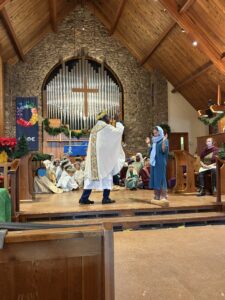
If you were at our Christmas pageant last December, you remember the scene in which Dion, playing the Angel of the Lord, brought to Layla, playing Mary, the news that she would be the mother of God’s Son. As the passage describing the angel’s visit was read out from the first chapter of Luke’s Gospel, the two actors mimed the scene, ending as Mary responded to Gabriel’s invitation, “I am the handmaid of the Lord; let it be to me according to your word,” and Dion gently folded his hands around Layla’s, affirming her decision, as the reader concluded, “And the angel departed from her.”
The Annunciation was on my mind because of a very routine practical question about the hymns for today. Last week, we sang a hymn to the tune of “Abide with me”, and this week, Chris sent me another text to the same tune. I hate “Abide with me,” and so I begged to use any other tune. The only one in Common Praise that fits the words is #362, “Tell out, my soul” – which, of course, is a retelling of the Magnificat, Mary’s song after she becomes pregnant with Jesus.
And re-reading the story of Jesus and the Canaanite woman for this Sunday, I realized that the last three lines of this passage are a strong echo of the Annunciation. In response to the Canaanite woman’s refusal to let herself be brushed off by him and the disciples, Jesus says: “Woman, great is your faith! Let it be done for you as you wish.” And, the passages concludes, “her daughter was healed from that moment.”
(Initially, I only noticed the similarity of the central sentence – Let it be/Let it be. It was only when I sat down to write this paragraph that I noticed the parallels between the handmaid of the Lord and the woman of great faith, and the way that each spoken quote leads into the sentence that concludes and sums up the episode.)
As far as I know, no scholar has ever supposed that the writer of Matthew had direct access to any part of the text of Luke (the standard hypothesis is that they were both working from and adapting Mark, as well as another manuscript that has since been lost.) So this parallel might be deliberate, or (more likely) it might just be the Holy Spirit getting up to her usual tricks. Either way, though, it really made me think about the connections between the Virgin Mary and the Canaanite woman.
On the surface, of course, about the only things they have in common are their gender and their motherhood. Mary is a young Jewish woman engaged to be married, portrayed as pure and demure; the Canaanite is “from the region of Tyre and Sidon”, associated with idolatry, an outsider to the disciples and their fellow Jews, depicted as shouting and pursuing them, making a nuisance of herself.
But both women encounter God, and while the encounter changes them, in both cases, it also changes God.
(Footnote here: traditional theology asserts that God does not and cannot change, which may be true from God’s perspective. But in the story of God’s interactions with God’s people, we certainly get the impression that God has changed. Which may be more about us than God, but is still an important part of the story.)
When Mary says, “I am the handmaid of the Lord; let it be to me according to your word,” her reply opens the way for God to become human and live among us, something that could not have happened without Mary’s willingness. (It’s been pointed out that God may have asked many others before finding someone who said yes.)
God could have blasted his way into the world and saved us all by force, whether we liked it or not, but instead God worked through a single, ordinary human being, who opened her heart and risked her life in order to unite God to humanity and allow God to understand the experience of being human from the inside.
When that baby grew up and became a prophet, healer, and teacher, he was fully God and fully human. And this encounter with the Canaanite woman shows Jesus at possibly the most unappealingly human he is in any of the gospels.
Granted, Jesus and the disciples are probably still a bit off-balance and cranky: grieving the lost hopes represented by the recently executed John the Baptist, and exhausted from the bread-multiplying and water-walking episodes of the last couple of chapters. But still, they reject the woman four times. First Jesus ignores her, then the disciples tell him to send her away, then he “answers” – it’s not clear whether to them, to the woman or both – “I was sent only to the lost sheep of the house of Israel;” and even when she kneels before him, he insults her by implying that she and her child are dogs.
Ouch.
But the Canaanite woman doesn’t waste time arguing with them about the sneering, dehumanizing way they treat her; she is too desperate and determined for that. Seizing on the kind of comeback that would only occur to most of us at 3 am the following night, she snaps at Jesus, “Yes, Lord, yet even the dogs eat the crumbs that fall from their masters’ table.” And suddenly Jesus does a complete about-face, uttering the words that echo those that his mother spoke to the angel: “Woman, great is your faith! Let it be done for you as you wish.”
Both of these women taught Jesus. Mary, over years and decades, slowly, patiently, lovingly, comprehensively; and the Canaanite, in one charged moment, angrily, combatively and narrowly. But in both cases, the living God was taught, corrected, led to growth and virtue, by a woman.
No wonder not many have noticed the echoes and connections between the two stories. This perspective has not been a popular one for much of the church’s history.
But both of these episodes are turning points. In one, a human woman accepts the unimaginable responsibility of bearing Christ into the world, thus becoming an essential part of the process of redeeming humanity; and in the other, an outsider rebukes a prophet and demands that he (and his friends) acknowledge her essential humanity, and may, by doing so, have opened his mind to the possibility that he was not called only to the lost sheep of the house of Israel, but rather to everyone.
And both these episodes remind us that God chooses to allow himself to be frustrated, to be rebuked, to be changed by humanity. God did not become flesh in Mary’s womb until the angel had heard Mary’s “Yes”, and Jesus changed his mind when the Canaanite woman flared at him in anger. God respects the consent of our humility, but also listens to the outburst of our fury.
Each of us can be the servant of the Lord. Each of us can be a person of great faith. Each of us can humbly accept God’s will for us and thus change the world; or assertively refuse to accept the world as it is and insist that God get to work and make it better. Each of us can be visited by angels or receive healing. Each of us is part of the story of a God who became flesh and who lets himself be rebuked and guided, taught and changed, by those God has made, and loved, and chosen, and healed, and blessed.
Amen.
Leave a Reply