All Saints’, Dorval
Proper 12, Year A (National Indigenous Day of Prayer)
June 21, 2026
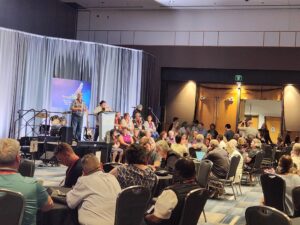
The Indigenous participants at General Synod 2025.
One of the things about Scripture – one of the reasons that Scripture is Scripture – is that its meaning is multivalent and inexhaustible. Or, to use plain English: it means a lot of things, and it never runs out of meanings.
This means that, because the Holy Spirit speaks through God’s Word, any passage from the Bible has something to say to any occasion, if you listen carefully enough.
Today is the National Indigenous Day of Prayer, and All Saints’ is well along in the process of complying with Primate Shane Parker’s request for parishes to fly the Survivors’ Flag as an expression of solidarity with the survivors of residential schools. Sandra Bender of the National Centre for Truth and Reconciliation presented us with a fact-filled webinar on the history at the beginning of the month (the recording is still available for anyone interested!) and in just a minute, Nancy and Marie-Claude will lead us in an interactive activity on the same topic. So this will be a very short sermon, and essentially I just want to dip into each of the readings and explore how they connect to the theme of the day.
Taking the Gospel first: “nothing is covered up that will not be uncovered, and nothing secret that will not become known. What I say to you in the dark, tell in the light, and what you hear whispered, proclaim from the housetops.”
The story of the residential schools was an open secret for two hundred years, and yet some people still managed to be shocked when investigations at the Kamloops Indian Residential School revealed anomalies in the soil that were consistent with the presence of burial sites. Stories of the abuse, suffering, starvation, sickness, disappearance and deaths of children were told over and over during the Truth and Reconciliation process.
For survivors, it must have felt – it may still feel – very much like the prophet Jeremiah’s descriptions of his compulsion to prophesy: “within me there is a burning fire shut up in my bones; I am weary with holding it in, and I cannot.” For the processing of trauma, it is essential to be able to share one’s story and be heard, believed, and supported. The school survivors’ trauma was compounded over decades of being ignored, dismissed, and even blamed for their own suffering. But, as Jeremiah continues, “the Lord is with me like a terrifying warrior; therefore my persecutors will stumble, and they will not prevail. They will be greatly shamed, for they will not succeed.”
To our eternal shame, the vast majority of the perpetrators of the residential school system were Christians, acting in the name of the Church, many of them Anglicans. That some Indigenous Canadians have maintained their faith in Jesus Christ despite the appalling way they were treated by his followers, is more than the Church deserves. And so it behooves us to listen attentively to St. Paul when he demands: “Should be continue in sin in order that grace may increase? By no means! How can we who died to sin go on living in it?” The grace extended to us by God and by those we have harmed is already infinite; now the harm must stop so that we can all be the children of God together.
All of us, Indigenous and settler, immigrant and refugee, have been united with Christ in a death like his and in a resurrection like his. We have been freed from sin and must live in that reality.
When we fly the Survivors’ Flag, we are making a commitment to be a community and a space that acknowledges history, takes responsibility for the pain it caused, and moves forward with respect and dignity for every human being.
Amen.
Leave a Reply