All Saints’, Dorval
May 31, 2026
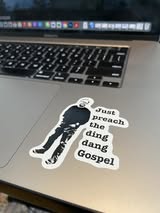
Sticker of Mother Kara Slade and her watchword, on the laptop of the Right Rev’d Frank Logue, Episcopal Bishop of Georgia
I’ve preached surprisingly few Trinity Sunday sermons in my eight years here at All Saints’ – and none in the past four years (2023: sabbatical; 2024; the Bishop preached; 2025: college reunion). And I’m that weird clergyperson who actually likes preaching on the Trinity!
So today I’m going to give you four years’ worth of the Trinity in a lump.
Today is the fifth Sunday of the month, when All Saints’ worship service is typically Morning Prayer. We took advantage of that fact to go back in time and do a full-scale Book of Common Prayer morning service, as would have been typical in a parish a hundred or so years ago. And such a service on Trinity Sunday would quite possibly have included the recitation of the Athanasian Creed.
The first thing to know about the Athanasian Creed is that it’s not actually a creed and Athanasius probably didn’t write it. The Apostles’ Creed begins “I believe” and the Nicene Creed begins “We believe”; they are statements of faith by the gathered body of Christ. The Athanasian Creed is a description, almost a report: “This the Catholic Faith”. (And we all know that “catholic” in this context is just the Greek for “universal,” right?)
St. Athanasius of Alexandria, that great theological warrior on behalf of the doctrine of the Trinity, died in 373 AD in – you guessed it – Alexandria, whereas the Athanasian Creed probably emerged around 500 AD, at the other end of the Mediterranean, in southern Gaul (modern France). So while the Creed can be said to more or less accurately sum up his doctrine, he had nothing to do with writing it beyond perhaps a general element of inspiration.
The Athanasian Creed started to fall out of favour in the nineteenth century because of the rather dramatic threats at the beginning and end, about how those who do not believe in the Catholic Faith “whole and undefiled” will “perish everlastingly” and likewise “those who have done evil [will go into] everlasting fire”. I hope I’ve preached enough about salvation here at All Saints’ to make clear that neither I nor the Church believes that God is gratuitously sending people to hell just because they have questions, or have never heard the gospel preached accurately.
Given the Athanasian Creed’s origins, I imagine these phrases being addressed to Saxon tribespeople who were more accustomed to hitting each other with axes than to thinking deeply on theological topics, and who needed to be told very clearly that they weren’t going to believe in Odin anymore. Today, we face a different set of social, ethical, and theological concerns – but we are still very likely to go astray if we don’t have a solid grasp of what we mean when we say that God is both three and one.
The Athanasian Creed is long. It’s dramatic. It has a lot of big words and a sort of vague, repetitive magnificence to the language. It’s easy to make fun of – “the Father incomprehensible, the Son incomprehensible, the Holy Ghost incomprehensible, the whole thing incomprehensible!” But I think it also represents something important.
I’m the first to admit that the Trinity is a mystery, the depths of which we will never plumb in our lifetimes. But that doesn’t mean we just throw up our hands and give up any effort at discovering the reality of God’s being or the ways in which God chooses to reveal themself to humanity.
St. Gregory of Nazianzus, a contemporary of St. Athanasius, wrote the following in his Oration in praise of Athanasius: “all the rest who sympathised with us [on the doctrine of the Trinity] were divided into three parties, and many were faltering in their conception of the Son, and still more in that of the Holy Ghost, (a point on which to be only slightly in error was to be orthodox)”.
“A point on which to be only slightly in error was to be orthodox.” You’ll never convince me that the Church Fathers didn’t have wicked – if bone-dry – sense of humour. But Nazianzus also has a genuine point: human error is always going to be a factor when we try to understand God, but it’s possible to get close enough for all practical purposes. And the effort still matters.
And in the solemn, rumbling clauses of the Athanasian Creed, we find both signposts to point us to God, and guardrails to keep us from going too far off track. We worship a God who is three and one, neither confounding the Persons, nor dividing the Substance. Father, Son and Holy Spirit are equal, yet the Son is begotten from the Father, and the Spirit proceeding from the Father and Son. The Trinity – all the Persons – is eternal, almighty, uncreated, God and Lord. Jesus Christ, meanwhile, the Second Person of the Trinity made human flesh in a particular time and place, is both fully God and fully human, “of a reasonable soul and human flesh subsisting,” yet “he is not two, but one Christ.”
The arithmetic is impossible, at least in the number of dimensions that we normally have available to our human experience, but that’s not important: just let it wash over you. The important part is to start to learn the shape of the pattern, of the three in one in their eternal dance, and the God in human flesh in his earthly manifestation, so that you can recognize where that pattern shows up in the world as you encounter it.
If you’re looking for it, it starts to show up everywhere. As my estimable colleague Kara Slade, theologian and priest in Princeton, NJ, wrote a few years ago, in a rebuke to clergy who make their curates preach Trinity Sunday: “The identity of God is shown to us in Jesus Christ by the power of the Holy Spirit! That’s good news! It’s the best news! It means that we know who God is, and that God is mercy, grace, and healing! Don’t try to explain the doctrine, just preach the ding-dang gospel!”
(Despite being separated by sixteen centuries or so, I suspect Mother Kara and Gregory of Nazianzus would have gotten along just fine.)
I do my best to preach the ding-dang gospel, and I hope I know better than to try to explain the mysteries of the Trinity; I prefer to wallow in them, to bow before them, to sing them, to dance with them, to get inside them and poke at their borders, to turn them upside down and shake them to see what falls out.
God made the cosmos, from galaxies to each hair of our heads; God’s word spoke creation into being; God’s spirit still endlessly breathes out the life of the universe.
God meets us in the created world of matter; God became flesh in Jesus of Nazareth; God births us in water and tends us like a mother hen.
God spoke over the waters; God gave us language at Pentecost; God speaks to us in our hearts and keeps God’s ears always open to our prayers.
All of this is true; it’s been true from the beginning; it was true for a highly educated bishop in Alexandria, for an axe-wielding tribesman in Gaul, for a one of our great-grandmothers reciting the Athanasian Creed at Mattins, and it’s true for us today, whatever the language we use for it.
The Father true, the Son true, the Holy Ghost true, the Three in One true.
The Father a mystery, the Son a mystery, the Holy Ghost a mystery, the Three in One a mystery.
The Father is love, the Son is love, the Holy Ghost is love, the Three in One is love.
This is the ding-dang gospel, and it is worthy of all to be believed.
Amen.
Leave a Reply