All Saints’, Dorval
May 17, 2026
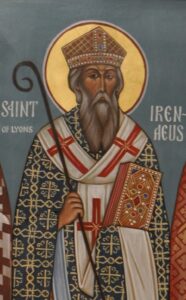
Icon of S. Irenaeus
The word “glory” or “glorify” is used six times in eleven verses in today’s Gospel reading from John. But what does “glory” mean, in this context?
If you were guessing based on the word alone, you might expect extravagant pomp and circumstance: crowns and robes, streets paved with gold, hosts of angels, trumpeters announcing the arrival of dignitaries. And there are places in the Bible where these things appear. The Revelation to John (a different John) is full of elaborate descriptions of the jewels that make up the walls of the holy city and the finery of the court that inhabits it. But this passage is something completely different.
This speech of Jesus’ comes from what’s known as the “Farewell Discourse” or the “High Priestly Prayer”, the long portion of the Gospel where Jesus is speaking to his disciples after the Last Supper. They are not in a royal court, human or divine. They are seated around a table in a very ordinary room, a group of fishermen and tax collectors and former revolutionaries, who have just finished eating a simple meal of roast meat and unleavened bread and wine. When they started fantasizing about being big powerful people and fighting about who was the most important, Jesus got up from the table and washed their feet to show them that they should be servants to each other. And then he began this discourse, which has become a prayer.
Jesus asks his Father to glorify him (Jesus) so that he may glorify the father – a reciprocal glory, each glorifying the other. Where does this glory come from? “Since you have given him authority over all people, to give eternal life to all whom you have given him.”
Eternal life? That means heaven, right? Surely we’re about to hear about people in shining robes sitting on clouds or streaming through the pearly gates?
Nope. “And this is eternal life, that they may know you, the only true God, and Jesus Christ whom you have sent.” Eternal life is knowing God in and through Christ.
And here comes the language of “glory” again. “I glorified you on earth by finishing the work that you gave me to do.” Glory is … work? That feels like the opposite of glorious to me, but who am I to contradict God? And I guess that if this crew of working-class people are the ones Jesus has chosen, it would make sense for glory to be something they understand and have experienced.
“Glorify me in your own presence with the glory that I had in your presence before the world existed.” Jesus in John’s gospel is a human being, for sure, but he is also clearly God. He is the Word that was in the beginning. And here, again, we are reminded that this Jesus was in God’s presence before the world was created. And yet, in some way that we cannot begin to hope to understand, as he sits among his disciples, wearing grubby everyday clothes, at a table covered with crumbs and used crockery, he is still in God’s presence – and he brings them into God’s presence through him.
“They were yours,” says Jesus to God of the disciples, “and you gave them to me … Now they know everything you have given me is from you, and they have received them and know in truth that I came from you, and they have believed that you sent me.” The relentless abstraction and repetition in these passages from John can make it very hard to pin them down long enough to understand them, but if nothing else, it’s clear that Jesus is trying to convey a deep sense of connection here: between him and God the Father, between him and his disciples, and thereby between the disciples and God the Father. Near the end of the passage, he sums it up: “All mine are yours, and yours are mine, and I have been glorified in them.” In this text, glory is connection and presence. It doesn’t have to be shiny to be real. God’s glory – God’s power and radiance and love – are shared through this sense of connection and presence, so that even if nothing changes outwardly, even if everything still seems very ordinary, God’s disciples are glorified.
You may have heard a quotation attributed to the second-century bishop Irenaeus – a protégé of the martyr Polycarp, as Polycarp was a protégé of John the Evangelist, so only two degrees removed from the text of this very Gospel. The quotation is usually phrased as “the glory of God is a human being fully alive.” This is not technically a misquote, as the words of Irenaeus (or rather, the Latin translation of his original Greek that has come down to us) can be construed that way. But the quotation is truncated and distorted to make it sound like Irenaeus thought that the fulfilment of each individual human being was the pinnacle of God’s glory, which is not at all what he was saying.
(To be clear: I think that God wills for each of us to be fully and joyfully alive, and rejoices when we are so. But that’s not the ultimate expression of God’s glory – there is something even greater. And that something is what Irenaeus was trying to express.)
What Irenaeus was saying was one of the great themes of all the early Christian writers: the way in which Jesus wondrously united heaven and earth, humanity and divinity. As translated by Robert M. Grant from the Latin (though I have replaced his masculine language with gender-neutral equivalents), Irenaeus wrote:
[Jesus] showed God to humankind and humankind to God, preserving the invisibility of the Father so that humankind would not become a despiser of God but would always have a goal toward which to advance, and at the same time making God visible to humans … so that humans might not be totally deprived of God and perish. For the glory of God is the living human being, and the life of humanity is the vision of God. If the revelation of God by the creation already gives life to all the beings living on earth, how much more does the manifestation of the Father by the Word give life to those who see God!
“For the glory of God is the living human being, and the life of humanity is the vision of God.” The second half of the sentence is as essential as the first. Essentially, Irenaeus is saying exactly what John has Jesus say in the Farewell Discourse: that humanity is glorified in connecting with God and being in God’s presence, and in some mysterious way, God’s glory, which is infinite, is yet augmented by humanity participating in it.
This past Thursday was Ascension Day, and St. Ephrem the Syrian, commenting on the Ascension in the fourth century, wrote something very similar:
‘Do you see then to what height of glory human nature has been raised? Is it not from earth to heaven? Is it not from corruption to incorruption? … But we … have not only been reconciled to God the Father, through our Lord Jesus Christ, but we have also soared aloft to sonship, and now our nature is worshipped in the heavens by every creature seen and unseen.’
“Now our nature is worshipped in the heavens by every creature seen and unseen.” Jesus took his human body with him when he ascended to be seated at God’s right hand and worshipped. This is extraordinary, unmerited glory, indeed.
Even the letter of Peter, our second reading, mentions “glory” three times, and in the context not only of the ordinary frustrations of daily life, but of actual persecution. We are glorified when we endure suffering and resist evil for the sake of God, and for the sake of goodness and love.
How would it change your thinking, and maybe even change your life, to understand glory not as gloss and glitter, fancy trappings and trophies, but as the simple fact of being in God’s presence, of connection and relationship, of oneness with the God who creates, redeems and sustains us?
“Holy Father, protect them in your name that you have given me, so that they may be one, as we are one.”
These words are as much for us as they were for the Twelve around that table, and they sum up the meaning of true glory.
Amen.
Leave a Reply