All Saints’, Dorval
May 3, 2026
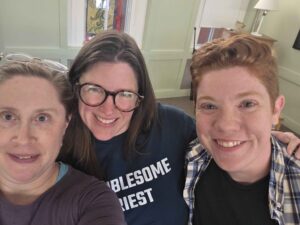
Part of the Alberta baptism working group.
Like newborn infants, long for the pure, spiritual milk, so that by it you may grow into salvation – if indeed you have tasted that the Lord is good.
Just over eighteen years ago, as the parent of a two-month-old, I preached a sermon on this passage from the first letter of Peter that dealt with the image of a nursing infant from the perspective of someone actively breastfeeding her own baby. He had been baptized just four weeks previously, welcomed into the family of Christ at the Great Vigil of Easter.
I spent many hours this week thinking, talking, and writing about baptism, as part of a working group of a dozen people from around the Anglican Church of Canada who have been in conversation for a year or so about the topic. Specifically, it began when a bunch of us found ourselves having similar chats with colleagues about how more and more of the baptisms we were doing, or being asked about doing, didn’t fit the “norm” of the Anglican Church of Canada (or, for that matter, the norm that my family had represented when Peter was baptized in 2008): two Anglican parents, both baptized as infants, bringing their child to be baptized as an infant.
More and more, people are coming to our churches from other countries, or other denominational backgrounds, or other life experiences, and asking questions about how their ideas of baptism fit into our traditions, and vice versa.
Right here at All Saints by the Lake, I’ve baptized many more older children, teenagers, and adults in the last four years than I have babies. Some are new to Canada; some have had backgrounds in traditions – such as the Jehovahs’ Witnesses – that don’t baptize, or understand baptism, the same way we do; some come from families where the parents are different religions and leave it up to the child to choose whether to be baptized; some just haven’t gotten around to it for whatever reason. Some check more than one of those boxes!
Three weeks from today, we will baptize Chris Brown, who is definitely not an infant, and whom I was very surprised to discover had not already been baptized! I am overjoyed that All Saints’ is the parish where he has chosen to make that commitment to Christ, and it will add an extra layer of rejoicing to a day when we were already celebrating the confirmation of three of our young people who were baptized within the past couple of years.
A big part of the working group’s conversations, and of the work we did in Alberta this week, was aimed at providing resources for priests, lay leaders, and baptismal candidates and their families about what Anglicans actually believe about baptism. Since we are Anglicans, those resources ended up being almost exclusively liturgical: either actual worship services (including one that arises out of and is designed for an Indigenous context), or commentary on the familiar baptism service in the Book of Alternative Services, explaining the thinking behind it, highlighting the many scriptural references, and clearing up some common misconceptions that come from folk beliefs about baptism and from traditions that practice believers’ baptism – traditions, in other words, that require the candidate to be old enough to make a verbal profession of faith before being baptized.
It can often be very confusing for people who have been brought up to believe that such a profession of faith is a requirement for baptism, to encounter the customs of a church that baptizes babies, even if they actively sought out that church because it believes in women’s leadership, in affirming LGBTQ+ people, in caring for creation, and so on.
Reading the letter of Peter over again this week, having returned from the working group meeting, I was surprised that in all the reading we’ve done about perspectives on baptism and their scriptural foundations, I don’t recall this verse being mentioned once. It seems quite relevant! It addresses a community of new believers, most of them presumably baptized as adults, but it casts them as spiritual infants, still in need of the pure milk that will help them grow into salvation. Perhaps, from God’s point of view, we are all baptized as infants, and God chuckles when he sees us thinking that we could really have any idea what we are committing to when we choose the life of faith.
One of the joys of baptizing people who are old enough to answer for themselves and who are already part of the community of faith, is that you can be pretty sure that they will keep showing up. And the thing I try hardest to convey to the families of babies and toddlers who have come and asked for baptism, is that that’s pretty much the only thing we ask in return: keep showing up. Keep engaging with this congregation, and through it, with God and the whole church. Keep listening to what we say in worship, and watching what we do as a result, and learning what it means to follow Jesus (even as imperfectly and incompletely as we inevitably do). Listen to the language we use when we baptize, and – as we say at Messy Church – be ready to hear the story, and let it change you.
Just a couple of examples of what I mean by this:
At the meeting of the working group in Alberta, one of the members told the story of a soldier who was stationed at Guantánamo Bay in the aftermath of 9/11. One Sunday, he happened to attend worship at an Episcopal church when there was a baptism. He heard the question, “Will you strive for justice and peace among all people, and respect the dignity of every human being?” The next day, he quit his job. He still believed that the prisoners at Guantánamo were terrorists, but he could no longer justify participating in their torture.
In January, just after the first murder in Minneapolis, a group of clergy gathered at a commemorative vigil. My colleague Melissa Pohlmann described her colleague, Martha Bardwell, invoking the baptismal covenant to the crowd:
She reminded Lutherans that when we come to the baptismal font we ask the congregation and the candidate, “Do you renounce all the evil forces that defy God,” and we say, “We renounce them.” So now we say do you renounce evil? And together the whole crowd shouted, “We renounce them.”
Living into our baptismal promises is a lifelong undertaking, whether we begin it at seven weeks or seventy years. All of us, together, long for the pure spiritual milk so that by it we may grow into salvation.
Toward the end of the passage from I Peter, the writer reminds his friends that “you are a chosen people, a royal priesthood, a holy nation, God’s own people.” We reference this line at every baptism, when the whole congregation says to the newly baptized: “We receive you into the household of God; confess the faith of Christ crucified, proclaim his resurrection, and share with us in his eternal priesthood.”
This is the paradox of baptism: that we are simultaneously infants who need to be fed on milk, and members of an immortal, royal priesthood. Whatever age we are when we are welcomed into God’s family, whether or not we have any idea what’s going on or what we’re getting ourselves into, we have been given mercy, and been called into God’s marvelous light.
Amen.
Leave a Reply