All Saints’, Dorval
August 2, 2026
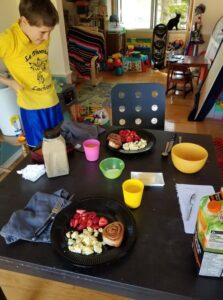
Peter admiring the cinnamon rolls during quarantine, July 2020.
***
I have great sorrow and unceasing anguish in my heart.
You who have no money, come, buy and eat!
They replied, “We have nothing here but five loaves and two fish.”
Today’s readings begin in grief, exhaustion, and scarcity. Isaiah the prophet speaks to those who have nothing to eat and no money to buy anything with. Paul laments over the rift between the Jewish people and the emerging Christian church.
And in the gospel, we hear the famous story of the feeding of the 5,000 (which, of course, was really the feeding of the 15 or 20 thousand, once you factor in the women and children!).
The story begins, “Now when Jesus heard this.” It would be easy to just skim over this phrase. But when the writer says, “now when Jesus heard this,” “this” is the news of the death of John the Baptist. News that one can imagine would be distressing for Jesus on at least two levels: the personal, because John the Baptist was a fellow prophet and (if you follow the account in Luke’s gospel) his own cousin; and the political, because if Herod Antipas was willing to cut off John’s head for uttering inconvenient truths, there was no reason to think the same thing might not happen to Jesus.
So Jesus wasn’t just tired. He was heartsick. Grieving. Probably scared. Wrestling with what the near future would look like and what would be demanded of him. I imagine that he felt like he had nothing left to give.
Grief, exhaustion, scarcity. Fear. Needing something – food, rest, comfort – and not knowing where it will come from.
Feelings with which I suspect we are, all of us, all too familiar.
In the gospel story, the crowds exacerbate the situation. Instead of leaving Jesus and the disciples alone to cope with the news they have just received, they “followed him on foot from the towns.” And Jesus, despite his depleted state, “had compassion for them and cured their sick.”
The word translated here, like its equivalent in Hebrew, is much more intense and visceral than the abstract English word “compassion” – a better translation might be something like “gut-wrenched.” Jesus feels the crowd’s desperation and cannot deny his own impulse to relieve it, even if it drains him further.
The disciples, presumably also exhausted, come to him at the end of the day and point out that it’s dinnertime and people need to eat. Jesus tells them that the crowd doesn’t need to leave, that they – the disciples – can give them food. The disciples protest, reasonably enough, that they only have enough food for a handful of people.
And then unfolds the classic shape of the miracle: Jesus tells the disciples to bring him the loaves and fish; he takes them, looks up to heaven, blesses and breaks them, and they are distributed to the crowd; “and all ate and were filled,” with twelve baskets full of leftovers.
Somewhere in there, we went from grief to rejoicing; from exhaustion to replenishment; from scarcity to abundance. Somewhere in there, the fear was relieved (although not for long; the next thing that happens is the episode of the storm on the Sea of Galilee, when the disciples in their boat are nearly swamped and then Jesus freaks them out even more by coming to them walking on the water).
The grief, the exhaustion, the scarcity, are our daily companions. Whether it’s the lack of sheer basic necessities, as in Isaiah; or seeing a community that is beloved to us torn apart, as in Paul’s letter to the Romans; or grieving the violent death of a friend and fearing the same fate for ourselves, as for Jesus in the gospel; or dealing with the sickness and disability of ourselves or our loved ones, as for the crowds; or being overwhelmed by the needs of others and having no idea how to meet them, as for the disciples … I’m sure you can fill in the blank for yourselves.
And much as we wish that God would just immediately fix our problems and meet our needs – or ideally keep us from ever having the problems or the needs in the first place – we know that that’s not how it works.
One thing the gospel story tells us, of course, is that even God – when God became flesh and lived among us as Jesus of Nazareth – was not exempt from the grief, exhaustion, scarcity, and fear. God heals us because God feels compassion for us, and we have to believe that that compassion is stronger – that it literally wrenches God’s gut – because God has known, himself, from the inside out, how it feels to need to be healed.
But the more important message, I think, is the loaves and fishes.
In this version of the story – unlike the one told in John’s Gospel – the small amount of food that is shared among the huge crowd doesn’t come from a little boy who selflessly offers his lunch to be shared. The disciples just have it with them. It’s nothing much – just the same dull staple meal that these people probably eat every day – but it’s what they have. And God takes it, and makes it into (locks eyes with my mother in the congregation) enough, and more than enough.
Six years ago, I wrote and preached a sermon on these same texts while quarantining in Hilary Bogert-Winkler’s house after Peter had visited his father in the US during the lockdown summer of 2020. I mentioned that a few days before, when we had gone into the quarantine, Rebecca Dowd Lekx had dropped off some surprise cinnamon rolls, which we ate for breakfast for a couple of days. And she wasn’t the only one to stop by with a gallon of milk, or a box of peaches, or a few ears of fresh sweet corn. We got through that quarantine with a little help from our friends.
When we are grieving, exhausted, fearful, suffering from a lack of the basics for survival – what we need may well not come with much fanfare. It may be there already, just waiting to be multiplied by God and nourish us. Or it may come seemingly at random from a friend or stranger. It probably won’t be glamorous – maybe just the same old bread and fish we’re used to eating. It may come from an unexpected place or at an unexpected time.
And, of course, sometimes we are the one doing the offering, giving someone something that seems impossibly small but that makes all the difference.
In fact, it strikes me that perhaps the most important message of this text is that we are none of us doing this alone. I said a minute ago that “we wish God would just immediately fix our problems and meet our needs – or ideally keep us from ever having the problems or the needs in the first place”. But imagine how much joy and connection and meaning you would miss if you really were a totally autonomous individual who didn’t need God and other humans.
And in the Gospel story, Jesus doesn’t give the people the food directly. Every bite passes through the hands of the disciples.
Isaiah – in a text chosen, of course, to resonate with the Gospel story – tells those who thirst to come to the waters: “you who have no money, come, buy and eat! Come, buy wine and milk without money and without price.”
The prophet notices that we don’t always know best how to relieve our own grief, our own exhaustion and scarcity: “Why do you spend your money for that which is not bread, and your earnings for that which does not satisfy?”
Maybe the simple bread and fish that God takes, blesses, breaks, and gives, is better than whatever shiny things we’re trying to soothe ourselves with.
“Listen carefully to me, and eat what is good, and delight yourselves in rich food. Incline your ear, and come to me; listen, so that you may live.”
We may begin in grief, exhaustion, scarcity, and fear; but God, in God’s mercy, doesn’t leave us there. And we are all called to be the ones who give, and the ones who receive.
Come, buy wine and milk, without money and without price.
And they took up what was left over of the broken pieces, twelve baskets full.
Amen.
Leave a Reply