All Saints’, Dorval
Reign of Christ Sunday
November 22, 2026
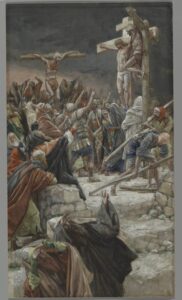
James Tissot, “The pardon of the good thief,” c. 1890, Brooklyn Museum
And these will go away into eternal punishment, but the righteous into eternal life.
This is the last verse of Matthew 25. Do you want to know what comes next, in the first verses of Matthew 26?
When Jesus had finished saying all these things, he said to his disciples, “You know that after two days the Passover is coming, and the Son of Man will be handed over to be crucified.” Then the chief priests and the elders of the people gathered in the palace of the high priest, who was called Caiaphas, and they conspired to arrest Jesus by stealth and kill him.
And from there we’re off, headlong into the story of Jesus’ arrest, trial, crucifixion, death, burial – and, of course, resurrection.
Just as today’s feast, the Reign of Christ, marks the end of the church year as we look ahead to the first Sunday of Advent next week, so this story of the Sheep and the Goats marks the end of Jesus’ ministry of teaching and healing, before he sets his feet irrevocably on the way of the cross.
I love the lectionary, but sometimes the way that we get little bits of scripture week after week keep us from seeing the larger patterns in the way the gospels are put together.
I should say before I go any further that the basic concept of this sermon and many of its details were stolen wholesale from my friend the Rev’d Greg Johnston of St. John’s Episcopal Church in Cambridge, MA, who blew my mind by pointing them out last week. But sharing the ways my mind has been blown by other people is one of my favourite kinds of sermon.
For the last three weeks, we’ve heard the three stories that make up Matthew chapter 25: the parables of the Wise and Foolish Bridesmaids, of the Talents, and of the Sheep and the Goats. Each of these is a vivid, beloved story, but each also contains harsh judgment: on the foolish virgins who ran out of oil, on the third servant who buried his master’s money in the ground, and on the “goats” who failed to care for the Saviour when they saw him in his guise as “the least of these”.
But then you read chapters 26 and 27, in which the sinless Messiah suffers and dies for those – for us – who are utterly unworthy of that sacrifice. And that story echoes, over and over, from the grandest themes to the tiniest details, the stories of failure and judgment that have been told in chapter 25.
The bridesmaids fall asleep, and the foolish ones run out of oil. A woman anoints Jesus’ feet with ointment and washes them with her hair. The disciples fall asleep, not once but three times, in the garden of Gethsemane.
The unworthy servant buries the talent in the ground, and Judas returns the thirty pieces of silver, unspent and uninvested, to the chief priests.
Jesus separates the sheep from the goats, the sheep on his right hand and the goats on his left, and then is crucified between two thieves, one on his right and one on his left.
“In other words,” as Greg put it, “Jesus’ final teachings before he dies are pretty harsh statements about eschatological judgment, and then he goes to give his life to save people who will never live up to them (past and present).”
(“Eschatological”, by the way, means “having to do with the end of the world,” so “eschatological judgment” is the judgment described in today’s gospel, in which the Son of Man comes in his glory with his angels and sits on the throne of judgment.)
I’ll say it again: “Jesus’ final teachings before he dies are pretty harsh statements about eschatological judgment, and then he goes to give his life to save people who will never live up to them (past and present).”
Judas betrays him, the authorities arrest and condemn him, the soldiers mock and flog him, and the rest of the disciples desert him. Rather than sitting on the throne sending the sheep to his right and the goats to his left, he is nailed to a cross between two criminals. (In the gospel of Luke, one of his fellow condemned men begs to be remembered when Jesus comes into his kingdom, and Jesus promises him that they will be together in paradise. But that episode is unique to Luke and doesn’t appear in Matthew.) Only the women, “looking on from a distance,” accompany him to the end – yet another echo of the parable of the bridesmaids, this time the wise ones who made it to the wedding.
The Son of Man, the King, comes in his glory, and his throne is a cross, his courtiers criminals, his crown made of thorns. And he is dying, not only for the virtuous sheep, but for all of us.
Because while the story of the sheep and the goats describes a clear binary between the virtuous sheep and the sinful goats, in reality, all of us have had times of caring for others and all of us have had times of ignoring others. We all live up to God’s love sometimes, and we all fail sometimes. And Jesus is King for us all, and dies and rises for us all.
Yes, we have ignored and neglected Jesus in the form of our brothers and sisters – but Jesus dies on the cross for those who have betrayed, deserted and tortured him. The story feels like a harsh judgment, but if you keep reading, it is a reminder to us of how we should respond to God’s overwhelming, overflowing, unconditional love.
This is the “riches of [Christ’s] glorious inheritance among the saints” that Paul describes in the letter to the Ephesians. This is “the immeasurable greatness of his power for us who believe … God put this power to work in Christ when he raised him from the dead and seated him at his right hand in the heavenly places, far above all rule and authority and power and dominion and above every name that is named, not only in this age but also in the age to come.”
In the face of a people who often behave more like goats than sheep, Jesus not only gives up his life, but brings us into his very body: “[God] has put all things under his feet and has made [Christ] the head over all things for the church, which is his body, the fullness of him who fills all in all.”
All the images we remember from the alarming stories are reflected and turned upside down in the tale of Jesus’ extraordinary love and sacrifice. What our King and Shepherd has done for us is beyond all hope and expectation. We can only give thanks, and try to live up to the love that he has shown us, in how we treat the least of those among us.
Amen.
Leave a Reply