All Saints’, Dorval
Proper 32, Year A
November 8, 2026
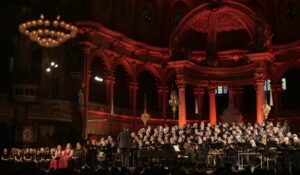
The McGill Choral Society performing “Carmina Burana,” April 2025 (my first concert with them)
***
Later the other bridesmaids came also, saying, “Lord, Lord, open to us.” But he replied, “Truly I tell you, I do not know you.”
Every Tuesday, my sermon discussion group organizes its conversations about the week’s Gospel passage around three questions:
What do you hear that is attractive?
What do you hear that is challenging?
What do you hear that is transformative?
Sentences like the one I quoted above from today’s Gospel reading from Matthew, often fall under the heading of “what is challenging”: anything that sounds like it is excluding people, especially when it seems like the reason for the exclusion (the lack of oil) could easily have been averted by a bit of basic sharing and planning ahead.
The reading from Thessalonians, meanwhile, if you come to it without context, sounds like it doesn’t have much of a downside at all – but of course this is the notorious passage that gave rise to the doctrine of the Rapture, which has spawned so much political nonsense and personal trauma among evangelical Christians since it was dreamed up less than two centuries ago.
And yet, when we discussed this Gospel passage, traditionally known as the Parable of the Wise and Foolish Virgins, on Tuesday, I remarked early on in the discussion, “I know with my head that there are all kinds of disturbing interpretations of this story, but in my heart, it’s just Bach’s ‘Wachet Auf’ cantata, so I love it.”
The main theme of “Wachet Auf,” as you’ve gathered by now, is the tune of Hymn 110, which we’ll sing at least once during Advent. The cantata has five main movements, and includes glorious solo and duet passages as well as the opening chorus and closing chorale. It is an extended fantasy on the soul’s reunion with her Maker and redeemer; the soul is symbolized by the wise virgin who rushes to bring her lamp when the bridegroom arrives – and crucially, it leaves out any reference to the foolish virgins. It intuits – correctly, I think – that they are, ultimately, not the point of the story. The story is about our longing to see our Saviour return to us.
The same – that the nasty elements or interpretations are not the point of the story – is true many times over for the doctrine of the Rapture relative to its source in the letter to the Thessalonians. As pervasive and pernicious as the Rapture has been since it was invented in the 1830s, it has in no way ruined for the rest of us the many hymns that we sing about being bound for glory on the far side of the river Jordan.
Sometimes the song is worth singing, even if some of the notes are sour.
Or maybe there’s even more to it than that.
I spent five hours yesterday at a rehearsal for the McGill Choral Society. (Our concert is the afternoon of November 29! Tickets are available now!) And a lot of what we were practicing, as we learned and polished Martín Palmeri’s “Misa Buenos Aires,” was how to hold our own note even when another voice part was singing a note that clashed with it. In other words, what we were practicing was the art of making ugly noises on purpose.
The Western musical tradition fundamentally relies on dissonance – notes that don’t “sound good” together, notes that sound “wrong” – as its essential structure. Music that’s worth listening to moves from consonance – notes that sound good – to dissonance and back, and usually finally “resolves” to a chord that’s in harmony. But the overall impression, despite – or rather, because of – the dissonance, is of fascination and beauty.
I think our stories are often like that, because our lives are often like that. If the theme is powerful, the dissonances, the funky places, the parts where things don’t line up neatly, are a crucial part of the overall effect.
When I was about 17, after six years of piano lessons but before I had taken any music theory classes, I tried to write an arrangement of Christmas carols for four voices. Because I knew how to assemble a major chord but had no idea what I was doing beyond that, I constructed the whole thing in consonant harmonies. Because those six years of piano lessons had not succeeded in making me a competent pianist, I never actually played the whole thing through at anything resembling the correct tempo, so I never heard how monumentally boring it must have been in real time, but looking back I can only laugh.
Music is about powerful themes, supported by a structure that includes dissonance as well as harmony. And the more I think about it, the more I think scripture works the same way.
The top-line themes in the Bible are impossible to miss if you read it with any degree of good faith: justice and mercy. Care for the widow, the orphan and the stranger, and care for God’s good creation. God’s steadfast love for humanity, and humanity’s persistent failure to respond to that love with the faithfulness and righteousness that it deserves, and the overwhelming grace and forgiveness that God nevertheless inexhaustibly offers us. The promise of new life on the other side of death.
These are the themes that are set to music in works like the “Wachet Auf” cantata and hymns like “Guide me, O thou great Jehovah” and “Shall we gather at the river?” Singing them helps us to reinforce where we should put our emphasis when we read the Bible – while not ignoring those places where the scriptural text does challenge or alarm us.
And I think it applies to our own lives as well. Goodness knows we’ve all had our share of dissonant chords and ugly harmonies. But what is the part of your life that you would choose to set to music if you could? What is the main theme? What makes you want to burst into song like the cast of a Broadway musical? What makes your heart thrill, despite – or perhaps because of! – the parts of it that are hard, or scary, or upsetting?
Perhaps not surprisingly, the Christian community also shows this pattern. Goodness knows there are lots of ways we can find to annoy each other within this small congregation, but taken together, we bring each other so much love and joy. And the church as a whole has committed very serious sins over her history, and continues to desperately need reform and accountability, and yet I can’t imagine abandoning this extraordinary experiment in following Jesus Christ and trying to live in the new life that God has already given us.
Someday – after the new creation, when we have all passed into eternity with our Saviour – all will be harmony. There will be no more misunderstanding, or abuse, or fear, or heartbreak.
And yet, I suspect the music will still be the same. Because the glorious chord is less glorious without the dissonance that precedes it. And if we’re not singing “Wachet Auf” in heaven, I don’t want to go there.
Amen.
Leave a Reply