All Saints’, Dorval
All Saints’ Sunday
November 1, 2026
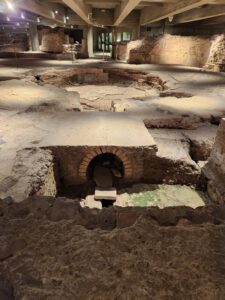
The font in the Milan Cathedral crypt.
Blessed are those who mourn, for they will be comforted. Blessed are the meek, for they will inherit the earth.
Blessed are … for they will.
All Saints’ Sunday, like so many other things about the Christian life, confuses our sense of time. Are the people Jesus is preaching to blessed now? Or only when their longings are fulfilled in some unspecified future?
As is so often the case, the answer is “yes”.
On this day in the Church, we celebrate the saints: past, present, and yet to come. We remember the great ones who have long since gone to be with God; we think of our beloved dead who have joined the church triumphant within the last few weeks or months; we welcome two brand-new saints, Gabryel and Azula, to God’s family through baptism; and we remember that someday we will be the ancestors in the faith to siblings in Christ who have not yet been born.
The longer I live, the more the communion of saints means to me. A bunch of you have heard this story, but I don’t think I’ve told it from the pulpit yet:
A bit more than three years ago, toward the end of my five-week trip through Europe on my sabbatical, I was in Milan. I am not usually a guided-tour person, but my travel agent had encouraged me to book one for Milan Cathedral, because otherwise the queue to get up on the roof can be hours long. So I showed up for the tour, and the guide took us down into the crypt below the west end of the cathedral, where the remains of the late Roman church lie underneath the current fifteenth-century building.
As we poked our way along the dirt floor among the ancient stones, I saw in front of us an eight-sided structure surrounded by a knee-high wall, and as the alumna of many university-level classes on ancient and medieval architecture and liturgy, I thought smugly to myself, “hey, that’s a baptismal font!” Within a few seconds, the tour guide had confirmed my conclusion – and then she kept going, and told us that this was the font in which St. Ambrose had baptized St. Augustine at the Great Vigil of Easter in the year of our Lord, three hundred and eighty-seven.
I was gobsmacked. I felt as though time had collapsed and the saints had stepped down out of their icons and were standing right there next to me. It made the communion of saints real to me in a way I have never felt before or since. I desperately wanted to linger and soak in the atmosphere, but the tour moved on and I had no choice but to follow.
It was particularly striking because just a week or so prior, I had been in Santiago de Compostela, the famous pilgrimage destination in northwestern Spain, where the legend that underpins the whole experience is manifestly nonsense. Nobody knows whose bones are actually buried in the reliquary at Santiago, but they’re not St. James the Apostle’s. That doesn’t alter the impact of fifteen hundred years of pilgrimage and devotion on that site! But it’s astonishing that the physical stones touched by two great saints of the early church are just sitting there under Milan Cathedral without anybody paying much attention at all.
Throughout my pilgrimages in the summer of 2023, it became clearer and clearer to me that that was the part of the experience that meant the most to me – the sense of walking behind and beside and among the faithful of every generation, who had walked these paths and prayed these prayers, from the tomb of a Compostela pilgrim at Worcester Cathedral in England, to the wayside markers guiding me to the shrine of St. Olaf in Norway, to the pilgrim blessing given by a priest in Porto, Portugal, to riding horseback through a village in Spain as mass let out on the Feast of the Transfiguration, exactly like pilgrims had done five hundred or a thousand years before, to the bustling offices in Santiago and in the Rome airport devoted to getting modern pilgrims and their mail and luggage to where they need to go.
Blessed are the pilgrims, for they shall be surrounded by the communion of saints.
And of course, while I certainly recommend going on pilgrimage to anyone who’s able to, our life itself is also a pilgrimage, even if we never travel anywhere in particular; and it is one that we take among a great cloud of witnesses, the saints past, present, and yet to come.
By the grace of God, and if we keep our hearts open, all of us will be, at one time or another, all of those things listed in the Sermon on the Mount: the poor in spirit, the mourners, the humble, those who long for righteousness, the merciful, the pure in heart, the peacemakers – and, very possibly, the persecuted, as well. Faithful people have been, and are, and will be, all these things, and those who are going through them now can be strengthened by those who have shown the way in ages past, and by trusting in the God who will continue to bless the generations who come after us.
Here at All Saints’ by the Lake, it has seemed over the past few months that we are in a particular season of mourning, as we have said goodbye to one after another of our beloved saints, honouring their lives with the same white hangings and some of the same hymns that we use today. Blessed are those who mourn, for they have been, and are, and will be comforted, not least by those who walk with them, ahead and behind and side by side.
Because of course we cannot separate Christian birth and Christian death; in baptism we are buried with Christ, and in death we join in his resurrection. Once again, time collapses, and we are united with all the faithful in Christ, past and present and yet to come.
And so, yes, we will be blessed, at that great feast that never ends, which we anticipate every time we gather around the altar and invite God’s presence into bread and wine. But also we are blessed, whenever we do God’s will, whenever we walk the path that has been made for us by those who have gone before us.
In God, all times are one; God’s blessing is eternal, and never fails; God’s work will be carried on by those who have not yet been born or thought of, long after you and I have gone to glory; and as we travel our earthly pilgrimage, the saints will step down from their icons and walk among us, if only we have eyes to see.
Amen.
Leave a Reply