All Saints’, Dorval
Proper 29, Year A
October 16, 2026
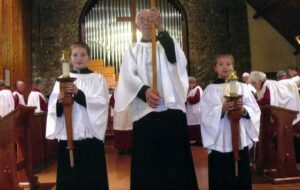
Gordon Hunter as crucifer with his grandsons, Liam and Declan, as torchbearers, circa 2014
I started this sermon at Non Solo Pane at about twenty past one on Friday, full of tea and pastries after Gordon Hunter’s funeral.
We’ve had too many funerals lately, but they do make you think about what it means to be made in the image of God.
Most of us have probably heard this gospel story many times; it’s both short and simple (at least on the surface). Two competing groups of authorities challenge Jesus to answer a question. It’s one that they knew was not just a matter of religious practice or interpretation, but could get him in seriously hot water with the Romans, the people who had the actual power: was it permissible, as Jews, to pay taxes to the Roman emperor?
Jesus asks them: whose image and title is on the coin? The answer is, of course, Caesar’s. (In this case, Tiberius Caesar, the successor to his stepfather Augustus, the first Roman emperor.) Jesus replies by telling them to give Caesar what is Caesar’s – implying that the coins for paying the imperial tax are relatively unimportant in the grand scheme of things – but to give God the things that are God’s.
The strong implication is that “the things that are God’s” is primarily us, because we bear God’s image in the same way that the coin bears the emperor’s image. And this has been the subject of innumerable stewardship sermons urging us all to offer ourselves and our possessions and talents to God – which is a completely valid take on the topic.
But this week I’m thinking about what it means, to have God’s image stamped on us, and to be together in community in the light of that knowledge.
Some of you – Chris, in particular, God bless him – have probably heard me preach enough funeral sermons to have a sense of what my typical structure is. I speak with the family – and, if I had the privilege of getting to know the deceased during their life, I draw on my own knowledge of them; I study the readings that have been chosen for the service. From there, I usually draw out one or two gifts or characteristics that were particularly typical of the person – something like generosity, or courage, or a love of music, or a love of nature, or some other positive quality.
I show how they lived out those themes in their life, and how the themes appear in the scriptures, and thus how this person’s life expressed a little bit of what God is like during their time here on earth. And then I reassure the congregation that it’s good to grieve for the people they loved, even though we rejoice that they’re now in heaven with God; and then I sit down and turn it over to the friends or family members who are giving the eulogies.
In other words, what I’m doing in a funeral sermon is articulating the particular way that this human being bore the image of God.
In this season in which we celebrate both stewardship and saints, it’s worth thinking about what gifts, talents, and fundamental characteristics we have that can help us show others what God is like during our time here on earth, and that can form the memory of us that those we love will hold onto after we’re gone.
The more time I spend with this congregation, the more joy I derive from seeing the image of God in each of you and watching you bring out that image in each other. And I think St. Paul (and Silvanus and Timothy!) felt very similarly about the Thessalonians.
Our reading today from Paul’s first letter to the church in Thessalonika is the first ten verses of the letter, beginning with the greeting. “We always give thanks to God for all of you and mention you in our prayers, constantly remembering before our God and Father your work of faith and labour of love and steadfastness of hope in our Lord Jesus Christ.”
Some of Paul’s letters are addressed to people he had never met – like the Romans – or people he was extremely angry at – like the Galatians. Thessalonians is not one of those letters. Paul had founded the church at Thessalonika; he knew these people well, he loved them, and he missed them when he was gone. (He had not left Thessalonika voluntarily; he had fled when his life was threatened, and the people he had left behind were still in danger of persecution.)
His affection for them overflows in this letter, as he commends them for their hospitality, their faith, and the example of courage that they are setting for other Christian communities throughout Greece. For Paul, the Thessalonians are showing him the image of God, as much as he is showing them.
That is what we do for each other in church. On Tuesday evening, I had a zoom call with the parents of little Azula, who’s charmed us all on several recent occasions when she’s spent part of the service toddling up and down these aisles. She will be baptized on All Saints’ Day, as will her father, Gabryel – an exciting occasion!
As we went through the baptism service with Gabryel and Laura and the godparents, and discussed the promises they would be making, I told them – as I always do on these occasions – that by far the most important thing to take away from the conversation is to just keep showing up, and if they did that, all of you would teach them what it looks like to be in Christian community and to serve others in the world.
We all bear God’s image – at two years old or twenty-two or eighty-two – and by God’s grace, as we go along, we can help each other polish up that image, rather than having it dulled and tarnished.
I find it so much more motivating and inspiring to be given an ideal to be lived up to, a vision that might become a reality, than to be scolded for what I’m doing wrong. Paul offers such a vision to the Thessalonians: “you became imitators and us and of the Lord … you turned to God from idols to serve a living and true God.” Jesus offers such a vision to the crowds listening to him in the Temple: sure, give Caesar the piece of metal with his face on it, but far more importantly, give God what is stamped with the image of God: your own selves.
I sincerely hope that I will not be writing a funeral sermon for any of you anytime soon. (For an encouraging number of you, your funeral sermons will be given after I’m retired or dead.) But the task of showing forth God’s image is a lifelong one, and in this season of stewardship and saints, it’s worth thinking about how yours will be described once your mortal journey is done – and how to polish it up and share it with the world, while there’s still time.
Amen.
Leave a Reply