All Saints’, Dorval
April 5, 2026
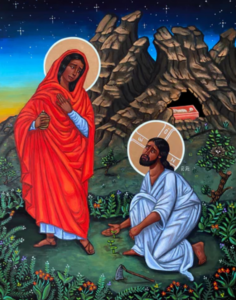
Icon of Mary Magdalene and Christ the Gardener, Kelly Lattimore, 2024
When she had said this, she turned around and saw Jesus standing there, but she did not know that it was Jesus. Jesus said to her, “Woman, why are you weeping? Whom are you looking for?” Supposing him to be the gardener, she said to him, “Sir, if you have carried him away, tell me where you have laid him, and I will take him away.”
For Easter this year, we read the story of the empty tomb from John’s gospel (rather than from Matthew, which was the other option), and as I reread it, the first thing I noticed was Mary mistaking Jesus for the gardener.
This is the only account of the resurrection in which this detail is mentioned, and it’s one of the ways in which John’s version of the story seems so human and down-to-earth (along with the carefully noted detail that the beloved disciple beat Peter to the tomb – you have to believe that he spent the next several decades reminding Peter of that fact).
But I don’t think that Mary’s looking at Jesus and seeing the gardener is just an incidental detail. I think it’s important in at least two ways – one looking back, and one looking forward.
This past Christmas, our church put on the Christmas pageant that my mother wrote when I was four years old and that my childhood church did every year throughout my childhood (and well beyond). The script is a dramatized service of Lessons & Carols, and like the classic version of that service, it begins in the garden, with Adam and Eve. As the reader reads the third chapter of Genesis, two children wearing muddy brown pajamas stand next to a large tree in the middle of the chancel, and act out the story of Adam and Eve being tempted by the snake, eating the apple, and being cast out of paradise as death comes into the world.
There at the very beginning of the human story, are a woman, and a garden, and God – as we all recall from that third chapter of Genesis, God “walking in the garden in the cool of the day”. And there at the climax of God’s rescue operation, as the power of death has been defeated and life bursts forth from the tomb, are the same three elements: a woman, and a garden, and God – and once again it is that dim and chilly time before dawn.
Thanks to the patriarchy, Eve has usually gotten far more than her share of the blame for the entrance of death into the world, and Mary Magdalene far less than her share of the credit for its downfall. In this scene, in the garden, encountering the risen Lord and hearing him call her name, Mary is the new, redeemed, and faithful Eve, longing to see her God and be known by him, rather than hiding in fear of God’s rebuke. And, of course, Mary goes forth from this encounter as the sole eyewitness to the fact that Jesus is alive: “Mary Magdalene went and announced to the disciples, ‘I have seen the Lord,’ and she told them that he had said these things to her.”
Mary, having been among the women who never abandoned Jesus during his execution, death, and burial, is now, in this moment, the single person on whom rests the fate of the good news of the resurrection. Had she stayed silent out of fear, the world might never have known. As Father James Martin puts it, “in the time between her encounter with Christ and her proclamation to the disciples, Mary was, in a sense, the church on earth. For only to her had been revealed the full Paschal Mystery.”
And in her, just as much as in Mary the mother of Jesus, Eve’s fault is redeemed and transformed. Mary Magdalene may have been mistaken in thinking that Jesus was a gardener who was a stranger to her; but in a very real sense, Jesus is the gardener, the one who tills the soil of the soul to plant in it the seed of new and inexhaustible life.
Thus, the way in which Jesus as the gardener looks back, to Eden and the very beginning of the story.
And this image also looks forward, of course, to the end of the story, to the new creation that someday will be the culmination of God’s redemptive work, when heaven and earth are reunited, death is not only overcome but annihilated, all tears are wiped away, and the holy city which is also a garden becomes the home of God and God’s ransomed people.
But the homely little details in this passage – the tombstone, the folded grave-clothes (with the head-cloth lying a little apart), the undignified race to the tomb, Mary’s confusion and distraction – are an essential reminder that even in the resurrection life, even in the new creation, we are still in the garden. We are still, literally, down to earth, with our feet in the dew-wet grass and the springtime soil. (OK, yes, it’s April 5 in Montreal and not quite barefoot weather yet, but we can feel it coming!)
Earth is not raised to heaven; heaven comes down to earth. Human bodies still matter, and God’s good earth still matters. The divine gardener, raised from death, bears wounded, living, human flesh. We believe in the resurrection of the body and the life everlasting. In an age in which the powers that be are doing their best to siphon off everything that makes us human and upload it into machines, and to suck the earth dry to add to their billions before it all collapses – in that world, still captive to death, Jesus appears to us in the garden in the sunrise.
He may warn Mary not to touch him yet, but he certainly invites her, and us, to – as they say on the internet – touch grass. Connect to the earth, to our own bodies, and to that good creation that sustains us.
The Resurrection is more than simply the annual awakening of the earth to growth, but it certainly includes that awakening. The sweetness of the wet garden, the way that what dies comes back to life, is perhaps the strongest image we have for the new life we are offered through Jesus’ sacrifice and triumph.
A woman, and a garden, and God. There at the beginning; anticipated at the end. And here, in this moment, in this very human encounter between Mary and her friend, the teacher, the gardener, in the hush before the world learns that Jesus is alive, and nothing will ever be the same.
Amen.
Leave a Reply