All Saints’, Dorval
April 3, 2026
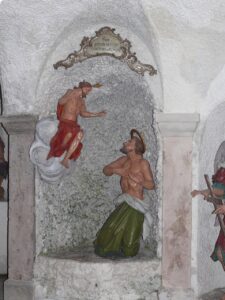
Christ and the Penitent Thief, Kerkerkapelle, Bad Tölz, Kalvarienberg. Wikimedia Commons.
For the past few months, I’ve been working with a couple of other clergy on a new catechism for the Anglican Church of Canada. A catechism is a list of questions and answers about the church’s beliefs, designed to be a teaching tool for confirmation classes and other contexts; those of you who grew up in the church may have been required to memorize portions of it. We’re a bit more flexible about these things today, but writing a catechism turns out to be quite a complex process.
We’ve solicited feedback from many people, and every round of feedback leads to – it sometimes seems – an exponential increase in the number of potential changes, additions, and corrections. Who is going to be using this document? How much can they be expected to understand? How much citation and explanation is reasonable before thing becomes, as the kids say, “tl;dr”?
One of the thorniest issues is, not surprisingly, the concept of sin. It’s a loaded word, people bring their own very different personal experiences and histories to it, and it’s been wildly misinterpreted and misused for many centuries in the church. At one of our recent meetings, the other two team members and I found ourselves discussing a question about the confession of sin – individual confession (yes, we have that in the Anglican tradition!) and the general confession that we say every Sunday – and wondering how much the typical person in the congregation actually understood about what is happening when we confess.
And Good Friday seems to be as good a day as any to discuss it.
We began this season of Lent on Ash Wednesday, with the Litany of Penitence, which you can find starting on page 283 of the BAS. That Litany begins, “We have not loved you with our whole heart, and mind, and strength. We have not loved our neighbours as ourselves. We have not forgiven others, as we have been forgiven.” It then goes on to enumerate many categories of sin, broad enough that most of us have probably committed them on a fairly regular basis: sloth, hypocrisy, self-indulgence, lack of charity.
As we begin the Lenten journey, we remind ourselves of the many ways in which we are guilty. And we do this together, in a public worship service; nobody is exempt.
We do it on Ash Wednesday at greater length than usual, but we make this confession every Sunday, usually right before the Peace. “Most merciful God,” we say, “we confess that we have sinned against you, in thought, and word, and deed, by what we have done and by what we have left undone.”
Sometimes, when saying the confession, I am acutely conscious of some particular way in which I have sinned the previous week. More frequently, I just have a general sense of culpability, that I along with every other human on the planet has been part of hurting those more vulnerable than me, harming the earth, and grieving the heart of God.
Because the Anglican way of handling confession is deliberately designed to address both of these states of mind. Yes, we each have specific sins to atone for; but also, each of us is inescapably entangled in the collective guilt of all of humanity, what is known by the technical theological term original sin, even if the ways that sin manifest in each of us is unique.
On the fifth Sunday in Lent, we used the words of the Wee Worship book from the Iona Community, and though I love the standard confession, I found it refreshing and consoling to hear a sense of penitence expressed in new language:
All the rumours we have heard about you [God] are true: you love, you forgive, you transform. And you know us – oh, how you know us. You perceive what in us needs to be loved, what in us needs to be forgiven, and what in us needs to be changed.
We confess, together, as a congregation, because we know we need to. No one is obliged to get into the specifics; no one is forced to put words to their own experience of sin. But confession – and what follows – are an essential part of what we do in worship.
And what is it that follows? Absolution – if a priest is leading the service, they pronounce over the people a specific formula that not only ensures but actually enacts God’s forgiveness. When we have finished praying the confession together and I make the sign of the cross over you, I have, by the power vested in me at my ordination, literally removed your sins, exactly the same way that happens when an individual makes a private confession to a priest.
That is why the confession is either the first thing that happens in the service – so that we can be fresh and clean for the rest of worship – or takes place right before the Peace, so that we can greet our neighbour in full reconciliation with God and each other, and proceed from there to the Communion table to receive God in Jesus’ body and blood.
(And as the priest giving the absolution, it’s an extraordinary blessing and privilege to convey that gift of grace from God – but it always feels a little odd to assume that it really has the same effect on me that it does on everyone else: so I always relish it when I get the chance to worship elsewhere and can receive the absolution of another priest or bishop!)
So what does this all have to do with Good Friday?
This confidence in confession, and assurance of forgiveness, is ours because of the sacrifice God made for us on the Cross. Sin and death are inextricably entangled, and Jesus has triumphed over both of them through his innocent suffering on our behalf.
But he was wounded for our transgressions, says Isaiah, crushed for our iniquities; upon him was the punishment that made us whole, and by his bruises we are healed.
In order for this to be good news, and not a kind of sadistic divine child abuse, we must remember that Jesus Christ was – is – not just an extra-special man, but literally God, and thus the atonement of the Cross is the atonement of the Maker of the cosmos pouring themself out for God’s wayward creation.
Why this is how it had to be is a mystery; the kind of mystery that can really only be understood with the heart and the gut, because the head will never really be able to wrap around it. And that’s why we come to this place, and do strange things like dancing with a wooden cross and singing about criminals’ legs being broken and eating the body and blood of God.
Maybe it will all make more sense on Sunday. But in the meantime, from the Litany of Penitence on Ash Wednesday to the Solemn Intercession and the Reproaches on Good Friday, and at every ordinary Sunday service all year round, we are reminded both that sin is real and that God in Christ has overcome it on our behalf.
Perhaps this Lent you have had an acute consciousness of the brokenness of the world and your own brokenness. Perhaps you have frankly not paid all that much attention. Either way, friends? You are invited to fall at the foot of the Cross, confess, give thanks, vow to live a new life – and be washed clean in the water and blood flowing from the Saviour’s wounded side.
Amen.
Leave a Reply