All Saints by the Lake, Dorval
March 1, 2026
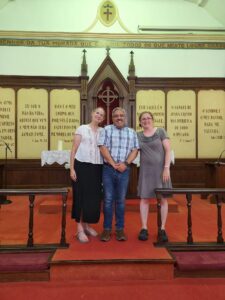
The Rev’d Laurie Brock (now Laurie Pankey), the Rev’d Jaime Dias, and me, after Jaime gave Laurie and me the Camino blessing at St. John the Evangelist Anglican Church, Porto, Portugal, August 2023
Now the Lord said to Abram, “Go from your country and your kindred and your father’s house to the land that I will show you. … and in you all the families of the earth shall be blessed.”
The clergy of the West Island met for our monthly gathering on Tuesday morning, and as we often do, we read and talked over the scriptures for the coming week. Reflecting on this brief passage from Genesis, we discussed how Abram (before God changed his name to Abraham) left home. This was a huge step to take in the environment of the ancient Near East, where family was paramount and children were expected to stay near their fathers and serve them loyally until the fathers died. (Abraham’s descendants traveled back to the family homestead and married their cousins for three generations, until the move to join Joseph in Egypt.) So if you left your country and your kindred and your father’s house – even at the ripe age of 90! – people would wonder whether there was something wrong with you.
Conversely, in North America in the 21st century, people are more likely to wonder whether there’s something wrong with you if you’re still living in your parents’ house when you’re 25.
This led to a fascinating conversation in which we compared our native cultures (amusingly, those present included exactly three people born in Canada and three in the US) in terms of whether they expected people to leave or not, and how they define “home”. Rural or traditional cultures where anyone who leaves is seen with deep suspicion (like Abraham’s); cultures like Newfoundland, where you might have to leave in search of education or employment, but the definition of “home” never changes; and the more cosmopolitan culture of the cities and coasts, where it’s absolutely expected that each generation will go away to university and then settle somewhere else entirely, and staying in the same place for one’s whole life is perceived as suspect.
Of course, these are never neat divisions. I belong firmly to the latter culture, with nowhere that has been “home” for any part of my family for more than one generation at a time. It was a little disconcerting for me to arrive in the biggest city I’ve ever lived in by a factor of ten, and realize that actually a lot of people here, even if they’re out of their childhood bedroom by 25, nevertheless grow up, get their degree, enter the workforce in specialized professional fields, and still never move more than ten kilometres from where they were born – which is arguably in many ways the best of both worlds, but still not at all what was modeled to me by the culture I grew up in!
As part of his command to Abram to leave everything that is familiar to him and risk the disapproval of everyone he cares about, God promises him that he will make Abram a great nation, and “in you all the families of the earth shall be blessed.” Staying near your family has many benefits: stability, help with the kids when you have them, a network to rely on if you get sick or need other kinds of support. But leaving home puts you in touch with the rest of the world. You encounter other families, and probably – by choice or necessity – assemble your own family. You have the chance to be a blessing, and to receive a blessing, in a larger context.
As we talked about this, it occurred to me that one concrete way that this is true for Anglicans is that we are a genuinely global church. I have lived in four countries and traveled to many more. I have been a regular worshiper at the University Church of St. Mary the Virgin in Oxford and the Anglican chaplaincy of St. Andrew in Zürich. I’ve helped with Holy Week services in Istanbul, been given a pilgrimage blessing in Portugal, and sat in a pew beneath the Canadian flag in Lima. I have former colleagues serving in Hong Kong and Australia, and current colleagues who hail from Zimbabwe and Haiti. We may not all use the exact same words of prayer that we used to, but the way we worship is recognizable enough that even when the liturgy is being conducted in a language I’ve never studied, I can have a rough idea of what’s going on.
We didn’t set out to become a diverse, interconnected, multicultural church. The Anglican Communion is rooted in colonialism, and we have much to repent for on that front. But by the grace of God, something true and beautiful has grown out of that sinful and violent beginning, and although there is still a long way to go, I believe that this worldwide family of Christians is indeed a blessing. And as Paul says about Abraham’s justification, not one that we have earned in any way by our works, but rather a free gift of grace from God.
In the Gospel reading, Nicodemus is deeply confused about how Jesus can be telling him that he needs to be reborn – or “born from above” – as an adult. But his ancestor Abraham could have told him what it means to be born into a new family, one that extends far beyond the bonds of location and blood relationship.
Right here at All Saints’ by the Lake, we are deeply blessed by the presence of people from all over the world in our congregation. It is not at all unusual on an ordinary Sunday morning for there to be people worshiping here who were born on five of the six inhabited continents.* (If you come from Australia, raise your hand!) Our baptism makes us one family, and that ensures that when we do leave home – because we want to, because God calls us to, or because we are forced to – we can be welcomed wherever we land.
I confess I am very tired of altering my sermons in response to the latest catastrophe in the headlines, but I would be remiss if I did not conclude this morning by remembering our siblings in the Diocese of Jerusalem and the Middle East and the Diocese of Iran, where the sins of greed, revenge, and sheer meaningless bloodlust have just expanded a simmering conflict to an all-out war. At the back of the church are printouts of a pastoral letter from Anglican Archbishop Hosam Naoum of Jerusalem, which I commend to you to read in full. He calls the global Church to “urgent, unceasing prayer” and reiterates that we refuse to see our neighbours as our enemies.
Right now, a pilgrimage group from my own home diocese of Connecticut, including a member of the church that sponsored me for ordination, is sheltering in St. George’s College in Jerusalem, unsure when or how they are going to be able to get home. Being members of the same family means that we rejoice with those who rejoice and weep with those who weep.
It would be easier to stay in our little enclaves and care only about those whom we have known all our lives. Or, alternatively, it would be easier to wander the world without roots or commitments, a perpetual spectator, never forming meaningful connections at all.
But in Jesus, we may not choose either of those options. Every Christian is our sibling, and every human is our neighbour. God has promised that in us all the families of the earth will be blessed. May God give us the strength to make that a reality.
Amen.
*On the Sunday morning on which this sermon was preached, this was indeed the case! There were people in the service who had been born in the UK, Ukraine, India, Zimbabwe, Nigeria, Ghana, Guyana, Trinidad, Jamaica, and the US, as well as of course Canada, and possibly other countries I’m not aware of!
Leave a Reply