All Saints by the Lake, Dorval
September 7, 2025
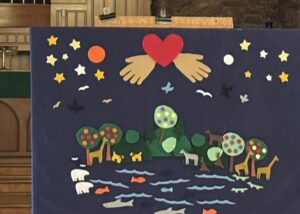
Every year at Messy Church, we begin with the story of Creation and Adam and Eve. God creates the world, earth and sky and sea, sun, moon and stars, birds and fish and animals, and finally humans. The script with which I tell the felt board story goes like this:
The people were made in God’s image.
That means they were like God!
They could love, like God.
They could make choices, like God.
They could make things, like God.
The world was very beautiful.
It was full of life.
God gave it to the people to love.
God gave it to the people to make things with:
To plant gardens and grow food,
To build houses and towns,
To make beautiful things to look and and touch and listen to,
To make up stories and songs and games,
To make friends and families and to live together in love.
Today is the first Sunday in September, which was just designated by General Synod in June as the Feast of the Creator, as part of the Season of Creation. The season and the feast are both part of an ecumenical effort, involving many different church traditions but led and inspired by the Orthodox churches, which have a long history of emphasizing Creation and the Creator in their worship. The feast is so new that it doesn’t have its own readings yet, but it nevertheless crops up in our readings for today in interesting ways.
During the debate about this motion at General Synod, Eileen Scully, the Director of Faith, Worship and Ministry at the national church office, pointed out that up until now, the Anglican churches have not had a particular feast devoted to God the Father as Creator, the first person of the Trinity. We have numerous feasts of God the Son, covering the events of Jesus’ earthly life and some of his divine aspects, such as Christ the King. We have Pentecost as the feast of the Holy Spirit, and Trinity Sunday to celebrate God as Three in One and One in Three. But before this new feast of the Creator was approved, the idea of God as Creator, as divine Maker of everything there is, was kind of taken for granted and went without saying – which, of course, is a recipe for it eventually being ignored and overlooked.
But in fact, the Church’s understanding of God as Creator and Maker is the foundation of everything else we believe. It is what gives meaning to Jesus’ identity as God’s Son, as God made flesh: that he is the same God who brought the cosmos into being. And it is what gives meaning to the power of the Holy Spirit: that through her, humans can come into direct contact with that very same creating force.
But perhaps even more crucially that what it tells us about God, our understanding of God as Creator is a profound statement about who we are, we who are made in God’s image. God made us – and God made us to be makers too.
As scientists investigate humanity’s earliest origins, one of the ways they distinguish “human beings” from our immediate hominid ancestors is by identifying when we began to make things: not just tools to help us with everyday tasks, but art – things which have no purpose but to be beautiful and to inspire reflection. Human culture is fundamentally a matter of making things: making and decorating objects, but also creating stories, songs, poems, dances, rituals; cultivating the growth of other living beings like garden plants and livestock; building buildings and roads and bridges and monuments; and on and on and on.
The metaphor of the potter, in today’s reading from Jeremiah, is a neat and handy example of this: God is compared to the potter as a straightforward way of symbolizing God’s power over the world and the people in it, but the very reason the metaphor works so well is that everyone Jeremiah spoke to would have instantly understood it, because they had their own memories of watching potters at work, and their own understanding of making things for themselves, whether pottery or other crafts.
It used to be that the overwhelming majority of human beings spent the overwhelming majority of their lives growing things and making things, out of sheer necessity. Much of this labour was difficult and exhausting; I don’t want to glamorize the hardships of the past. But people have always found ways to express themselves and add a little bit of personality and creativity to even the most mundane of tasks, from the Stone Age carver whittling the plain wooden butt of a spear into an animal head, to the Depression-era housewife making dresses for her children out of flour sacks that come pre-printed with floral designs for just that purpose.
People are makers, and in the last century or two, when much of the world’s work has shifted away from directly making things as more and more of that work is mechanized, it’s become harder for us to stay directly in touch with that essential element of our being. We certainly haven’t stopped making things! People who spend all day typing data into forms go home and write fan fiction on the internet; people who spend all day talking to other people on Zoom shut off the computer and knit and crochet (or, if they’re lucky, they can do it while talking to people on Zoom). But there is something deeply wrong with our understanding of what it means to be human when the most common way we are described by the media is as “consumers”.
The Feast of the Creator helps us to remember, not only who God is, but who we are: made by God the Creator, and made in the image of God the Creator: made, by the Maker, to be makers. The work of making is fundamental to who we are, and to our dignity as children of God. As Terry mentioned last week on Labour Day weekend, we need to remember to honour and respect those who come home from work and have to take a shower: those who work with their hands, making things, the largely invisible labourers who keep the world moving.
But of course that is not the only form of making. We create with our brains as well as with our hands; that’s why that kind of making is called “creativity”. And in an age of fast, cheap and disposable, an age of AI sludge and fast fashion, it is more important than ever that Christians reclaim the centrality of our belief in God as Maker and stand up for the value of good, honest craftsmanship, made to last, and of art made by human hands, that tells the truth.
“I will thank you because I am marvelously made;” says the Psalm; “your works are wonderful, and I know it well.” The best way to honour the Maker who made us is to take seriously the marvelousness of our making, and seek to create in the image of the Creator, putting our own individual mark on the world, on the wonderful works of God.
Amen.
Leave a Reply