All Saints’, Dorval
July 6, 2025
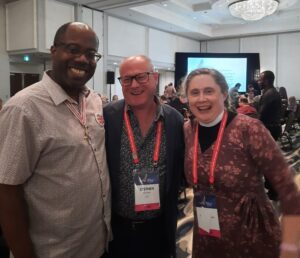
Dion Lewis (wearing his Anglican Award of Merit medal, as is permitted in the presence of the Primate); Stephen Kohner (son of Joan and Jeno); and Grace Burson, at the Farewell Banquet for Primate Linda Nicholls and Acting Primate Anne Germond, in London, ON, in June
As you probably know, I just got back from General Synod, the gathering of the whole Anglican Church of Canada that takes place every three years, and which was held over eight days at a conference centre in London, Ontario at the end of June. It was a remarkable experience, and there’s far more to say about it than could fit in a 1200-word sermon, hence why I’ve planned the “Lunch & Learn” session for the beginning of September. But I want to at least sketch some of my impressions this morning. And reading over the passage from Galatians, I was struck by how many clear resonances there are between the church that St. Paul served, and the one we are part of today.
To begin with the end of the reading: Paul begins the final paragraph of the letter by writing, “See what large letters I make when I am writing with my own hand!” He has dictated the bulk of the letter to a scribe, but as he approaches the conclusion, he takes the papyrus and the stylus himself and writes a few words directly – kind of like a contemporary Executive Director adding a handwritten note at the bottom of a printed form letter.
Paul recapitulates much of the argument he has made throughout the letter, about conformity with the Jewish law, such as circumcision, being unnecessary for being a follower of Jesus. And frankly, Paul has used some pretty extreme language in the process of making this argument throughout the letter. He’s said some things that make us raise our eyebrows, even two thousand years later when much of the context and complexities of the argument are lost on us. He has revealed himself, in many ways, as a crank with an axe to grind.
And cranks with an axe to grind are not in short supply at a gathering like General Synod. There were more than a few occasions on which Dion and I rolled our eyes practically out of our heads when we saw certain individuals step up to the microphone.
Yet the apostle Paul is also one of the greatest figures in all of Christian history, and the collection of very imperfect humans that constituted the 44th session of the General Synod of the Anglican Church of Canada also managed to listen to the Spirit and do God’s work together (even if there were more proposed amendments to motions than was strictly necessary).
We certainly didn’t agree on everything; sometimes it seemed like we agreed on hardly anything. There were contentious resolutions about disability theology, about environmental concerns, about funding for Indigenous ministries, about LGBTQ+ advocacy. If there was one thing I learned from the conversations throughout the week, formal and informal, it’s that there are no neat and tidy dividing lines. The settler church is trying with tremendous goodwill to support and reconcile with Sacred Circle, the emerging autonomous Indigenous church, and yet many of the members of Sacred Circle hold views on matters like fossil fuels and gay marriage that are hard for some of us to swallow. There is no “us” and “them”; there are many unique individual children of God trying to serve and love God and their neighbours as best they can in extraordinarily challenging circumstances.
Do not be deceived; God is not mocked, for you reap whatever you sow. If you sow to your own flesh, you will reap corruption from the flesh, but if you sow the Spirit, you will reap eternal life from the Spirit. So let us not grow weary in doing what is right, for we will reap at harvest time, if we do not give up. So then, whenever we have an opportunity, let us work for the good of all and especially for those of the family of faith.
Among the many possible definitions of “the flesh” (Greek sarx) as Paul uses the word, are greed and division. As the commentator Brigitte Kahl puts it, “Sowing to your own flesh by ignoring the needs of others, or by declaring their difference the limit of our shared humanity, means cultivating the Flesh as the metaphorical soil that brings forth a harvest of death and decay.” Conversely, sowing to the Spirit means recognizing the full humanity and interconnection of all of us in God, understanding that God’s grace and presence are not pie, that I get less of if you get more.
And despite all the messiness and frustration of trying to do God’s work through the very blunt tool of parliamentary procedure, I recognized at General Synod a real spirit of cooperation and generosity, of being willing to bear each other’s burdens as we seek to follow God into a new and uncharted era.
Because indeed, we are called to “bear one another’s burdens, and in this way you will fulfill the law of Christ.” And yet, a few sentences later, Paul says, “For all must carry their own loads.”
Maybe Paul is just free-associating here – goodness knows this isn’t the only time he contradicts himself. But also, I think both these things can be true. Each of us is responsible for ourself: for making our own choices, for not blaming others for our own behaviour, for doing our best to contribute to the good of the whole. And also, we are all bound up together in our common life, as the Body of Christ, and our most essential work is to understand each other and learn to work together to love, serve, and worship God.
The Anglican Church of Canada is embarking – has already embarked – on an uncertain journey in hard and scary times. There are huge challenges to be faced. (More about that at the Lunch & Learn!)
But we have each other. We have extraordinary leadership – from the Acting Primate and the newly elected 15th Primate, to the astonishingly smart, committed, and energetic youth delegation. We have done, and will continue to do, real and serious good work toward becoming the Church that God wants us to be.
Like St. Paul, we can be cranky and contrarian. But like St. Paul, the Holy Spirit is working in us, and there is no limit to what She can do. We must continue to bear each other’s burdens, and to sow the Spirit’s good seed in the Spirit’s good soil, for the sake of the good of all and especially of the family of faith.
Amen.
Leave a Reply