All Saints by the Lake
December 10, 2023
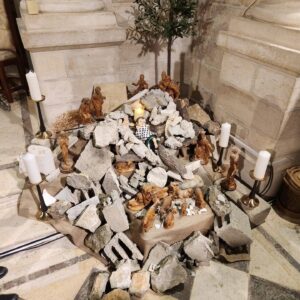
Munther Isaac is the pastor of Christmas Lutheran Church, in Bethlehem, in the West Bank. Last Sunday, he posted a remarkable picture to his congregation’s Facebook account – the picture you can see in the slide accompanying this sermon. It shows this year’s Christmas crèche at Christmas Lutheran: a loosely swaddled infant lying on top of a pile of broken concrete. The accompanying caption reads:
Christmas in Palestine this year. The Child under the rubble. Immanuel God is with us in our pain and suffering. God in solidarity with the oppressed. The child of Bethlehem is our hope. For the children of Gaza and all victims of wars. In Gaza today, God is under the rubble. He is in the operating room. If Christ were to be born today, he would be born under the rubble. We see his image in every child killed and pulled from under the rubble. In every child in incubators.
The image has gone viral, and with good reason: it’s powerful, heart-wrenching, and thought-provoking. And several weeks before Advent started, the Christians of Palestine had already announced that this year, they would forgo public celebrations of the Christmas season: no trees, no lights, no outdoor markets, no parades with marching bands of small children playing festive tunes. Some estimates put the percentage of Bethlehem’s economy that relies on such tourist-friendly attractions to be upwards of 90%, so even given that tourism was likely to be down this season thanks to the conflict in Gaza, this is a huge sacrifice. Religious services will, of course, continue, though even those will have a mood of reflection and remembrance.
A CNN opinion piece on the topic quoted Bishop William Shomali, the General Vicar and Patriarchal Vicar for Jerusalem and Palestine of the Patriarchate of Jerusalem, as he emphasized the somber mood behind the decision. “How can we celebrate Christmas when thousands of Palestinians got killed and injured and thousands of houses were destroyed in Gaza?” he told the article’s author, adding, “The same atmosphere of sadness prevails for the Israeli civilian losses. It is time for compassion and solidarity, not for joyful and worldly celebrations.”
Here in North America, we are half a world away from the conflict in the Holy Land, and wondering how we can respond to the violence, death, and grief. Of course we can and should continue donating money to relief organizations, calling upon our political leaders to broker peace, and signing letters that affirm the dignity and worth of all human beings. But I wonder whether the renunciation of Christmas trappings by our Christian siblings in Palestine this year might also be a fruitful invitation to consider our own Christmas traditions.
We had two lockdown Christmases, and in 2022 and 2023, we have thrown ourselves frenetically back into the celebrations that we had been denied for so long. And of course there is so much that we would not miss for the world: not being able to travel to see loved ones was the worst of it, and lockdown also made traditions like the Christmas baskets much more challenging to carry out.
But we all also know that it’s all too easy for beloved traditions to tip over into excess: too many presents, too much spending, too many events, cocktails, late nights, rich treats. We no longer live in a society where we worry that the sun won’t rise again after the longest night or harvest won’t last through the winter, and the line between rejoicing, celebrating, feasting, on the one hand, and overindulgence on the other, isn’t always clear.
Neither, for that matter, is what any given person means when they use the word “Christmas”. Is it Santa and reindeer and packages wrapped in shiny paper? Is it mistletoe over the mantel and roast goose on the table while carolers ring the doorbell and demand hot wassail and figgy pudding? Is it standing in the snow ringing a bell for the Salvation Army? Singing the descant to “O come, all ye faithful” at a quarter to one in the morning? And what do any of these traditions have to do with the purported reason for the season, the birth of one particular child into a poor family on a night in Bethlehem, roughly two millennia and three decades ago?
It’s worth thinking about why we are so attached to our traditions, and what we would say if we were asked to explain why we do them to a member of Christmas Lutheran Church, Bethlehem – or, for that matter, to John the Baptist.
Because here’s John, showing up every year like he does in Advent, wearing scratchy clothes and eating weird food, to yell at us all for being a brood of vipers, and call us to repent and prepare for the coming of Jesus. (We’ll see quite a bit more of him next week in the Christmas pageant!) I can imagine John, counter-cultural as he is, having very strong opinions about how we celebrate Christmas.
But perhaps it isn’t so much about the how as about the why. Whatever your beloved customs, think about why you do them. Do they bring you comfort and joy? Or are you carrying on with them out of a sense of guilt and obligation? Are your celebrations true to who you are, now, or are they trying to maintain a reality that no longer exists? Are they focused solely on your own family and those who already have plenty, or do they reach out and include the lonely and needy, and others most particularly beloved of God? And most importantly, do they reflect the love and mercy of the child of Bethlehem, or are they in service to the relentless logic of capitalism?
One Christmas “tradition” that I confess I find completely appalling is the Elf on the Shelf. (I put “tradition” in quotation marks because this was not something that existed as recently as my own childhood – the book was published in 2005.) If we want someone surveilling and passing judgment on our behaviour in the lead-up to Christmas, John the Baptist would be a much better candidate, with his call to repentance and renewal; or the innocent civilians currently in danger in the Holy Land, with that region’s crying need for reflection and reconciliation.
If nothing else, we will continue to gather here, in this place set apart for prayer, where light shines in the midst of darkness, banners call us to Hope, Peace, Joy, and Love, and empty mangers await the birth of the Christ child. But we will remember our fellow people of faith – Christians, Jews, and Muslims – living in grief and fear, and we will carry in our minds the image of a manger made of rubble, and all the children who have no safe place to be in this holy season.
In solidarity with them, the World Methodist Council has invited churches this year to extinguish the second candle of the Advent wreath. I quote from their announcement:
As we prepare ourselves to welcome the birth of the Prince of Peace, we understand the festive lights that normally shine bright in Bethlehem will not be lit this year in memory of those killed in the recent violence. To stand alongside our sisters and brothers in Christ, and all who mourn this Christmas, we will leave our second Advent candle unlit during Advent and Christmas.
Amen.
Thank you so much for this thoughtful and thought-provoking homily. I and so many of us are wrestling with the meaning symbolised by the Christ child in the rubble.