All Saints’, Dorval
July 5, 2020
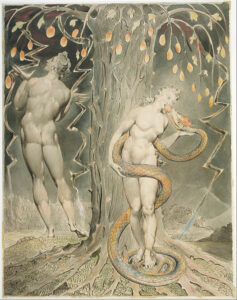
William Blake, The Temptation of Eve
We come with self-inflicted pains
of broken trust and chosen wrong;
half-free, half-bound by inner chains;
by social forces swept along;
by powers and systems close confined;
yet seeking hope for humankind.
Paul’s lament in the final portion of the seventh chapter of the letter to the Romans describes an experience that I think everyone can relate to. “I do not do what I want,” he marvels, “but I do the very thing I hate!” After an extended description of how he knows what is the right thing to do and yet cannot summon the will to do it, he cries, “Wretched man that I am! Who will rescue me from this body of death?”
We have all had these moments, of knowing what we should do and not doing it, or knowing what we should not do, and doing it anyway. But not all such moments are the same.
The Western churches have, over the course of Christian history, tended to overemphasize individual sin and individual responsibility. Interpreters have seen the individual human soul making a choice essentially independently, struggling alone with temptation and law, and being rescued by God’s grace.
Early commentators, interestingly, tended to use the example of anger: that a person knew that getting angry was wrong, and yet did so anyway. Later, in the Middle Ages and onward, “sin” was, predictably, reduced mostly to the sins of the flesh, and the temptation with which the soul was struggling was understood to be probably that of lust.
One of the major developments in western Christian theology over the past hundred years or so has been the rediscovery of the understanding of sin as systemic. That much of what we do that we know to be wrong and destructive is not as simple as a matter of individual choice; that we are, to a large extent, stuck in systems that we have not created and have limited power to change, but that constrain our behaviour in innumerable ways.
The verse of the hymn that I quoted at the beginning elegantly expresses this continuum: the “self-inflicted pains of broken trust and chosen wrong” are the individual sins, but they are only the beginning of our brokenness: there are also the “social forces” and the “powers and systems” that keep us imprisoned in wrongdoing.
Generational patterns of abuse, oppressions such as sexism, racism, and homophobia, the subordination of people to markets and economics, the inevitable corruption of power, and the destruction of the very basis of life itself in the form of the natural systems of the planet: all these, in innumerable ways, set at odds what we know to be right with the actions we take to get through the day.
Consider the simple action of standing at the gas pump filling your car’s tank. You have to do it, because there are places you need to go in order to fulfill your responsibilities. And yet you know that by doing it, you are participating in a systemic horror that is slowly suffocating God’s good creation. I can will what is right, but I cannot do it. For I do not do the good I want, but the evil I do not want is what I do.
One of the reasons that we have become so much more aware of the systemic level of sin over the past few decades is that mass media has made it impossible to ignore. It was one thing to see sin as mostly a matter of one’s own and one’s neighbours’ personal failings, when oneself and one’s neighbours were the entirety of the world that most people experienced. But as printing, radio, television, and the internet have made the world increasingly interconnected and communication increasingly instantaneous, we’ve come to understand how thoroughly we depend on each other and how extensively we impact each other, and the suffering and struggle of people around the world is present in our living rooms, 24 hours a day – especially in times like those we are living through right now, when an invisible pathogen is threatening health and life around the globe.
If we have any empathy at all, this can be overwhelming. We have a much larger understanding of the brokenness of the world with a not much greater ability to change and influence it than we ever did. This larger understanding can be paralyzing. We could be forgiven for ending up, like Paul, in the rhetorical dead end of “Who will rescue me from this body of death?”
And yet, what does Paul say next after that hopeless lament? “Thanks be to God through Jesus Christ our Lord!”
And the next chapter begins with the resounding declaration, “There is therefore now no condemnation for those who are in Christ Jesus.”
Where on earth did this come from? How did we go from being hopelessly stuck in systemic brokenness, to rejoicing in deliverance through Christ?
It’s the same question raised by the Gospel reading, in which Jesus, after upbraiding the faithless generation that has not listened to his message, invites his followers to “Come to me, all you that are weary and are carrying heavy burdens, and I will give you rest. Take my yoke upon you, and learn from me; for I am gentle and humble in heart, and you will find rest for your souls. For my yoke is easy, and my burden is light.”
We might be forgiven for thinking, “Really? A Saviour who demands literally everything from us, who exhorts us not to rest until the Kingdom of God has been realized on earth, and now he’s telling us that his yoke is easy and his burden light?” How do we get from there to here? How do we get from “The evil I do not want is what I do,” to “there is now no condemnation for those who are in Christ Jesus”?
On one level, of course, the answer is simply that: Jesus. But how can that feel real to us, on the emotional level, when we are still caught up in these oppressive and sinful systems from which it feels that we cannot escape? How do we come to a place where we truly feel the lightness of the burden and the easiness of the yoke?
If the problem is that the whole human race is inescapably intertwined in a system of sin, then the solution is for the whole human race, through Christ, to be intertwined in a system of salvation and solidarity. Paul’s lament that he cannot do what he knows to be right is what happens when an individual soul is confronted with a terrifying, oppressive, sinful system of power.
What Christ has done is to create, by his death and resurrection, a system of grace and salvation in which we are all likewise connected. We are the body of Christ, the communion of saints, the power of hope and life and salvation arrayed against the death-dealing principalities of this world. We do not have to face those principalities alone.
It may begin with something as simple as – to invoke last week’s Gospel reading – giving a cup of cold water to someone who is standing up against one of the sinful powers of this world. To paraphrase the Jewish proverb, we are not obliged to complete the work, but neither are we permitted to desist from it.
But when we know that Christ is with us, and that we are surrounded by a great cloud of witnesses, then we truly feel the peace that passes all understanding. We know the lightness of the burden and the easiness of the yoke, even as we still face the reality of the world’s overwhelming brokenness. And we can rejoice, with Paul, to say, “Thanks be to God through Jesus Christ our Lord!”
And that is, indeed, where our hymn ends up:
Then take the towel, and break the bread,
and humble us, and call us friends.
Suffer and serve till all are fed,
and show how grandly love intends
to work till all creation sings,
to fill all worlds, to crown all things.
Great God, in Christ you set us free,
your life to live, your joy to share.
Give us your Spirit’s liberty
to turn from guilt and dull despair
and offer all that faith can do
while love is making all things new.
Amen.
Leave a Reply