All Saints’, Dorval
March 15, 2026
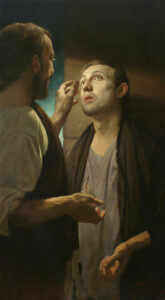
“Christ and the Pauper”, Andrei Mironov
Today’s Gospel reading is the third of four very long selections from the Gospel of John. They come from the third, fourth, ninth and eleventh chapters respectively, but they are clearly written to echo and interact with each other: key words and themes keep recurring, and deepening in meaning as they do so.
Each passage centers around Jesus’ interactions with one person: first, Nicodemus, the leader of the synagogue, who comes to Jesus in secret; then the Samaritan woman, who meets him by the well at noon; then, today’s reading, a man blind from birth, whom Jesus heals; and finally, next week, Lazarus, Jesus’ close friend, whom he raises from the dead.
Each of these people has a different social location and a different set of questions for Jesus. Nicodemus, the one who supposedly has the most power and status, is the most fearful and confused: he comes to Jesus by night, and rather than moving from questions to answers, his conversation with Jesus moves from answers to questions, seemingly leaving Nicodemus less certain of what to think than when he started.
The Samaritan woman, a member of a marginalized community whose way of worshiping does not meet the standards of the religious authorities, nevertheless boldly engages with Jesus about his role as a prophet and his offer of living water, and ultimately brings her whole community to believe in him.
Today’s protagonist, the man blind from birth, has been excluded from society by his disability, having no choice but to make his living by begging, but like the woman at the well, he is self-confident and curious, insisting on the facts of the situation when everyone around him is trying to cover their butts and complicate matters; and at the end of the story, he too becomes a disciple.
Lazarus, meanwhile, is the closest to Jesus and also the one in the most extreme situation, having literally died before Jesus arrives to bring him back to life. And in that story, it is not Lazarus whom Jesus engages with, but his sisters, Mary and Martha, as they grieve outside his tomb.
Each of these people must assess who Jesus is and how they are going to respond to him. This is not easy or without risk, as he seems to be creating controversy and upheaval wherever he goes. Is the power of who he is and what he says enough to overcome that hesitation? Does the prophet in front of them fit their image of the Messiah whom they are hoping for, and if not, do they change their expectations, or decide that Jesus is not the one who is to come?
In each of these conversations, there is a moment when this question is posed – sometimes clearly and definitely, sometimes more subtly.
Nicodemus: “He came to Jesus by night and said to him, ‘Rabbi, we know that you are a teacher who has come from God’ …” This is as close as Nicodemus gets to even hinting that he wants to ask the question of whether Jesus is the Messiah.
The Samaritan woman: “The woman said to him, ‘I know that Messiah is coming. … When he comes, he will proclaim all things to us.’ Jesus said to her, ‘I am he, the one who is speaking to you.”
The man born blind: “Jesus heard that they had driven him out, and when he found him he said, ‘Do you believe in the Son of Man?’ He answered, ‘And who is he, sir? Tell me, that I may believe in him.’ Jesus said to him, ‘You have seen him, and the one speaking with you is he.’ He said, ‘Lord, I believe.’ And he worshiped him.”
And in the story of Lazarus: “Jesus said to [Martha], ‘Your brother will rise again.’ Martha said to him, ‘I know that he will rise again in the resurrection on the last day.’ Jesus said to her, ‘I am the resurrection and the life. Those who believe in me, even though they die, will live, and everyone who lives and believes in me will never die. Do you believe this?’ She said to him, ‘Yes, Lord, I believe that you are the Messiah, the Son of God, the one coming into the world.’”
These four people are in very different places as far as how well they know Jesus, how much they trust him, what questions they have for him, what they expect from him, and how far they are prepared to go in response to him. Something they have in common with each of us, today.
Two thousand years later, it’s likely that we have different questions for Jesus. For us, the title “Messiah” may not feel terribly relevant, or may have become so overused as to be meaningless. We may want to ask, “Why should I believe that you have anything to say to me and my life?” or tell Jesus that it feels unfair that Nicodemus and Martha got to talk to him face to face and we don’t. But while the specifics may have changed, the reality of encounter with God in Jesus of Nazareth has not.
Maybe you can point to an experience that you’ve had that felt like a direct encounter with Jesus. Maybe you can’t – and that’s fine too. Some of us encounter God in Jesus in private and personal ways, and some of us connect with him through reading God’s word and participating in God’s sacraments – just as we’re doing now. Neither mode of encounter is more or less valid.
What we can learn from these stories is that if our questions are real, Jesus will listen, and engage with us, and tell us things that will probably confuse us, but will also stick with us and continue to inspire us for years to come.
Even Nicodemus – he sounds so hapless when he visits Jesus by night in chapter 3, but he doesn’t give up. He is briefly glimpsed in chapter 7 of the gospel, speaking up on Jesus’ side in a discussion with the rest of the council; and then in chapter 19, when Joseph of Arimathea donates his tomb for Jesus’ burial, Nicodemus contributes a hundred pounds of embalming spices. Like the Samaritan woman, the Orthodox Church venerates him as a saint, trusting that this gradual movement toward Christ continued beyond the Resurrection and the end of the gospel.
The Samaritan woman and the man born blind are converted and come to believe in Jesus as the Messiah, the Son of Man, as a result of their encounters with him. Martha, beside the tomb of her brother, already knows, believes, and follows Jesus as the Messiah – but in her grief, she cannot quite take the additional leap when he tells her, “I am the resurrection and the life.”
Jesus doesn’t force us to get all the way there in one leap. Some do, and some don’t. All of us, whether we get there sooner or later, are then called to spend the rest of our lives living more deeply into the promise of who Jesus is and what God can do for us, a promise that is inexhaustible, in this life or beyond it.
Rabbi, we know that you are a teacher who has come from God.
He cannot be the Messiah, can he?
Lord, I believe.
I am the Resurrection and the Life.
Amen.
Leave a Reply