All Saints by the Lake, Dorval
February 15, 2026
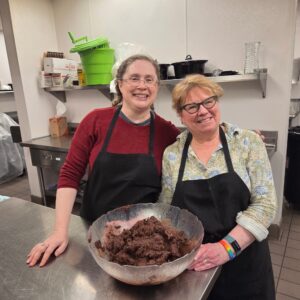
Me and Kristy Barnes of Hennepin Avenue United Methodist Church, Minneapolis, in the church kitchen making lunches for teachers at a local elementary school targeted by ICE, Wednesday, February 11 (yes, that is several pounds of chocolate buttercream frosting. Sometimes ministry is delicious!)
One of the things you hear a lot about in seminary, or any place that people are training for ministry, lay or ordained, is the “ministry of presence”. And the ministry of presence is simple: just being with people, without having to do much of anything, or find the perfect words to say. Showing up when someone is mourning. Being a visible and well-known part of your neighbourhood and community, instead of closing your front door and never talking to anyone (or, in the case of some churches, driving in from the suburbs on Sunday morning and never being seen during the rest of the week).
I confess that when I was in seminary, I had a hard time with this concept. I am an intensely product-oriented person. I want to go off into a corner and make something amazing and then come out and show it to people when it’s done. I don’t want them watching me during the process. I’m bad at small talk, especially with people I don’t know, and when my job is just to be there, it often feels incredibly awkward.
Where I really learned the value of the ministry of presence? Was in birthing rooms.
I trained as a doula in 2014 and attended my first birth just over 11 years ago, at the end of January, 2015. I attended a lovely couple as they had their third baby, it was all very quick and straightforward, and I honestly felt like I got a ton out of the experience and contributed very little. But they were so grateful. And that pattern has held ever since.
A doula is equipped for the work with information, training, and capable hands, but the principal way she makes a difference is just by being there. (There have been studies. If doula care were a drug, it would be unethical not to prescribe it.) As a doula, there are long stretches of time when all you’re doing is observing. Watchfully waiting. “Holding space.” You probably shouldn’t be talking much. You’re just there, and that’s all that’s called for in the moment.
The Transfiguration is one of those stories that I get to (have to) preach on every year, and this year the frame through which I’m looking at it is this frame of presence.
Because if you think about it, very little actually happens in this story. Jesus brings the disciples up the mountain. They see him transformed, and Moses and Elijah speaking with him. Then the vision disappears, the cloud passes, everything goes back to normal, and they go down again.
The Transfiguration is a story about what it means to be there, to see something happen. Both the disciples showing up along with Jesus, and Moses and Elijah showing up in the vision. Peter, James, and John know that being chosen for this experience makes them part of Jesus’ inner circle. And they know by the simple fact of Moses’ and Elijah’s presence during it, that it must be significant. Those two giants of Israelite history would not be there if it weren’t. The presence is the point.
It may not be especially logical, but one of the things that means the most to us as humans is just being there – or having others show up for us.
As you probably know, I spent from Monday evening until Friday morning of last week in the Twin Cities of Minnesota, because I had felt powerfully called to go there (by which I mean, it was driving me up the wall not to be able to go yell at ICE agents in person, and the Holy Spirit made the trip happen with remarkable speed).
I did my best to be useful while I was there. I helped pack and deliver food for families who were afraid to leave the house. I did school patrol. And I did, in fact, get to go to the Bishop Henry Whipple Federal Building and yell and blow my little whistle as convoys of spanking-new SUVs drove into the parking lot at dangerous speeds, belying ICE’s claims that it will soon be withdrawing from the area.
(The building named after Bishop Whipple being used to hold people in detention in horrendous conditions is a particular and painful kind of blasphemy, given that he was the first Episcopal bishop of Minnesota, serving for more than forty years, and was a well-known defender of immigrants, the poor, and Indigenous people.)
But my point is, I may have been able to offer some slight relief to a couple of overworked volunteers in the enormous mutual aid operation that the Minneapolis area has become over the past two and a half months. And it certainly felt essential, to me, to show up and be a witness. But it’s impossible to logically justify why so many people were astonished to discover that I had come all the way from Montreal, and thanked me profusely for coming.
On Wednesday afternoon, in particular, I found myself at Zion Community Commons, a hardscrabble little Lutheran church in St. Paul whose commitment to the neighbourhood predates the current crisis by many years, and whose whole tiny building has been taken over as a community kitchen and supply depot. It was a very slow day for what is usually a nonstop operation, and although I did my share of hauling bags of cornmeal and bagging frozen chicken breasts, there was also a lot of time to just hang out and talk. And the leaders who were there were very clear that they saw this as just as valuable and essential to their mission as the more active parts of the work. (I hadn’t even come the furthest that day – there were people there from DC and Oklahoma.)
Just being there. Just showing up. It seems like nothing much, but it expresses to people on the deepest level that they matter, that their experiences are seen and recognized, that they are not alone.
While in the Twin Cities I received the news of the horrific shooting in Tumbler Ridge, British Columbia. And yesterday I saw the photos of the vigil there, which the Prime Minister and a number of other dignitaries attended. Again: Mark Carney showing up in a tiny village in interior BC can’t bring these people’s kids back, or materially affect their circumstances much at all. But it nevertheless means everything that they were there.
The Transfiguration revealed who Jesus really was, but it didn’t change anything about the trajectory of his story. He still ended up detained, tried, tortured, and executed by the state. And yet, Peter and James and John being there, Moses and Elijah appearing, made all the difference, by ensuring that he wasn’t alone, by indicating the importance of the even with their presence, and by anticipating the final revelation that came after the detention, the trial, and the execution.
When I reassure people that God is with them in their doubt, fear, and suffering, I often wonder if it helps at all. But if it means so much for our friends, or our fellow congregants, or the Prime Minister, or some random person from Montreal, to show up when we’re diagnosed with cancer or going through a divorce or have lost our child to gun violence or are under siege by our own government, then maybe it does make sense for us to be comforted by the assurance of God’s presence, even if we can’t see it.
So let us cultivate the ministry of presence. Let us get over our hang-ups about being useful, or making small talk, or feeling awkward. Let us just show up, to feed each other, to hold each other, just to be there. And sometimes – perhaps every time – we will witness something extraordinary.
Amen.
Leave a Reply