All Saints by the Lake, Dorval
February 8, 2026
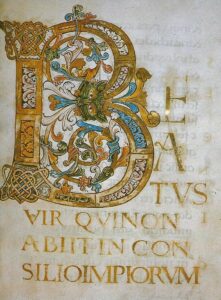
Incipit of Psalm 1, from the 10th-century Anglo-Saxon Ramsey Psalter
We should probably talk more about the Psalms.
The director of the Yale Institute of Sacred Music, which was providing the scholarship that paid my seminary tuition, was a medieval musicologist who was obsessed with the Psalms. Any time she opened her mouth at a colloquium, we knew that eventually she would mention the Psalms. Many was the time I silently rolled my eyes and mouthed, “OMG, Margot, enough about the Psalms already!”
Well, after praying the Psalms pretty much daily for twenty-five years, I have to admit – Margot was right.
As the Evening Prayer group knows, if you pray the Daily Office, morning and evening, every seven weeks you will make your way through all hundred and fifty of the Psalms; that’s approximately seven full trips through the Psalter every year. That means that even accounting for missing one occasionally, I’ve prayed every Psalm about hundred and sixty times since starting seminary.
We only get a tiny fraction of those Psalms on Sunday mornings, and overwhelmingly, what we do get is the happy bits: the songs of praise, the thanksgivings, the blessings. And when there is a verse that might be a little disturbing, it’s often listed in brackets, as optional.
Today’s Psalm, 112, is a case in point. (If you want to look at the text for reference, it’s on page 860 in the green book.)
“Praise the Lord!” it begins. “Happy are those who fear the Lord, who greatly delight in his commandments. Their descendants will be mighty in the land; the generation of the upright will be blessed.” And it goes on in this vein for nine verses.
But then comes verse ten: “The wicked will see it and be angry; they will gnash their teeth and melt away; the desire of the wicked will perish.”
Chris and I had a whole email correspondence this week about whether we would include this verse. And I get the impulse to make some Psalm verses optional; sometimes you’re trying to streamline the service for other reasons; sometimes you just don’t have the space to give them the attention they need in preaching.
But it’s really important for us to understand the depth and complexity of this book, the ancient hymnal of the Jewish people, whose words are omnipresent in the New Testament, and which Christians have been praying, and finding meaning in, for two millennia. It’s not just a series of short happy songs. The longest Psalm has 176 verses. The Psalms contain praise, thanksgiving, blessing, and the recounting of God’s mighty deeds in history; but they also contain lament, despair, rage, and furious calls for vengeance.
The very morning that I wrote this sermon, the Psalm at Morning Prayer presented me with these verses:
Let the table before them be a trap and their sacred feasts a snare. Let their eyes be darkened, that they may not see, and give them continual trembling in their loins. Pour out your indignation upon them, and let the fierceness of your anger overtake them. Let their camp be desolate, and let there be none to dwell in their tents. For they persecute him whom you have stricken and add to the pain of those whom you have pierced. Lay to their charge guilt upon guilt, and let them not receive your vindication. Let them be wiped out of the book of the living and not be written among the righteous.
Of course, those verses are in brackets; but if you haven’t encountered a headline over the past decade that has made those words deeply necessary, you haven’t been paying attention.
There are some very ugly things in the Psalms. But then, there are some very ugly things in the human heart, and the Psalms are the poetry of the human heart par excellence.
Arguably, the primary purpose of having daily morning and evening prayer is to form those who participate as people of the Psalms. The Psalms are powerful the first time you read them, but infinitely more so the hundredth time. And when you’ve prayed them for long enough, they get in your bones. Verses crop up as you go through your daily life, echoing the experience of people who lived three thousand years ago but who felt the same things that we do when looking at the night sky—or gathering their family around the dinner table—or helplessly and angrily wondering when God was going to deal with the people who were oppressing and abusing them.
To be a people of the Psalms means to be absolutely certain of a few basic things – that God is good, and God’s creation is good; that people are nevertheless frequently awful; that redress does not always come in God’s time; that nevertheless we may always cry out to God for that redress to come; that God has acted powerfully in history; that God may act powerfully again in our time, and through us; and that there is always hope that the humble will be lifted up and the rich sent empty away. (Mary’s song sounds like a Psalm. That’s not an accident. Jesus’ mother was just as immersed in the Psalms as he was.)
To be a people of the Psalms means to be salt of the earth and light of the world. The Psalms are not fancy. They are down to earth in the most literal sense. They reference the mud and mess of the human condition. They describe people crying so hard that the blanket they are sleeping on is soaking wet, and so full of despair that their hearts pound and they black out. Although the Psalms precede Christ and can certainly be prayed by those who don’t believe in Christ, they are fundamentally incarnational. Their refusal to ignore or deny human suffering resonates with Paul, who comes to the Corinthians resolved “to know nothing among you except Jesus Christ and him crucified.” And they are fully aligned with the prophet Isaiah, who demands of the people not elaborate rituals of worship, but the practical righteousness of feeding the hungry, housing the homeless, and “not hid[ing] yourself from your own kin.”
It is, once again, Annual Vestry Sunday: our eighth, here at All Saints by the Lake. And we could do worse, as we gather to reflect on our ministry and anticipate how we will love and serve God and our neighbour in the coming year, than to resolve to be people of the Psalms. I don’t think it’s that much of a stretch, to be honest. We’re a pretty down-to-earth bunch of folks. We support each other through the good times and bad. We show up in practical ways for each other and for our neighbours. We are unwilling to make peace with oppression. And we are learning to be less tongue-tied about what God has done for us – learning to give our testimony, learning (as Psalm 40 puts it) to proclaim God’s righteousness in the great congregation.
“Then you shall call, and the Lord will answer,” says Isaiah; “you shall cry for help, and he will say, ‘Here I am.’”
Those who pray the Psalms do so in a neverending conversation with God, a conversation in which nothing is off limits, and in which the participants grow ever closer and more intimate through the language of these ancient poems. Let us be people of the Psalms.
Amen.
Leave a Reply