All Saints by the Lake, Dorval
January 18, 2026
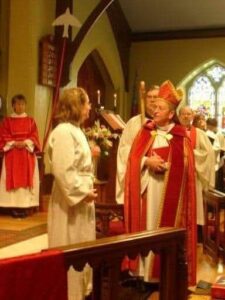
My ordination to the priesthood, Grace Episcopal Church, Manchester, New Hampshire, January 17, 2009.
Last week, we heard Matthew’s account of Jesus’ baptism. And when Jesus had been baptized, just as he came up from the water, suddenly the heavens were opened to him and he saw God’s Spirit descending like a dove and alighting on him. And a voice from the heavens said, “This is my Son, the Beloved, with whom I am well pleased.”
Our reading this week is from John’s gospel, and interestingly, it doesn’t actually say in so many words that John baptized Jesus. But it does tell us: “And John testified, ‘I saw the Spirit descending from heaven like a dove, and it remained on him. I myself did not know him, but the one who sent me to baptize with water said to me, “He on whom you see the Spirit descend and remain is the one who baptizes with the Holy Spirit.”’”
This vision – the dove descending, the voice from heaven – is described in all four gospels. It’s never clear whether the onlookers see and hear it as well, or only Jesus. But we do know that there’s one other person who definitely saw it happen, because John’s Gospel says so: John the Baptist.
And that got me thinking about what happens when God calls one of us – and when another person witnesses that call.
As most of you know, I’m the Sunday school lady’s daughter. I was – it may shock you to hear – a precocious, bookish, nerdy, extremely churchy child. I was an acolyte, I read Scripture, I sang in the choir. By the time I was ten or eleven I had Very Definite Opinions about the way church should be done. So it’s probably no wonder that by age twelve or so, people were asking me if I was going to be a priest when I grew up.
In my teens, I mostly brushed them off. I was going to be a famous novelist, or maybe make a killing putting on Broadway musicals, or get a glamorous job in the publishing industry. I needed to figure out who I was separate from my mother, and jumping immediately into the family business gave me no room to do that. The first person who asked me if I was called to the priesthood in a way that I could hear, was the chaplain of the Oxford college where I spent my third year of university. Many other voices chimed in before I finally entered the formal ordination process five years later.
When guiding people who are discerning a call to be a deacon, priest, or bishop, the church insists that the candidate’s internal sense of call must be echoed by what the people around them see, hear and experience from them. No vocation occurs in a vacuum. Figuring out who are called to be is a conversation between us, our community, and God.
When I was an ordination candidate, the people whose job was to evaluate me – bishops, other diocesan staff, my seminary professors, my sponsoring rector (who was also my internship supervisor) and others – often seemed remote and all-knowing. Some of this had to do with the fact that I was still very young by most standards and they were all much older, but I think it’s also just human to think of the people who are passing judgment on you (even if they’re also supposed to be supporting you) as being mysterious and powerful.
But I’ve since realized that they were probably just muddling through like all the rest of us – as I’ve come to be the internship supervisor, and various other forms of mentor, for more than one student and ordinand myself, and have realized just how limited is my ability to claim to speak for God or understand what another person should do. Really, we’re all just listening for God’s voice together. (I just wish that our policies and procedures were more oriented in that direction rather than towards a confusing and often unhelpful hierarchy.)
And that’s what Jesus and John the Baptist are doing in this passage. Up to this point in the story, John has appeared to be the more important figure – he has an established ministry and following, whereas Jesus has come out of nowhere. But, as John says, “After me comes a man who ranks ahead of me because he was before me.” And from this point onward, as John will say in chapter 3, “He must increase, but I must decrease.” In fact, one could argue that this moment, with John’s disciples transferring their allegiance to Jesus and John confirming the signs that he has seen of Jesus’ calling to God’s service, is the moment when the two are most equal, balanced at the midpoint on a see-saw that will soon drop precipitously as John is arrested and executed by Herod.
My mentor is not John the Baptist, and I am most definitely not Jesus, but with him having just announced his retirement while I am (as of yesterday) seventeen years a priest, and just days away from the exact midpoint of my career, this sensation of the passing of the torch, the changing of the guard, is something I can relate to.
Much more important, though, is to highlight the persistent theme of calling in these readings – the Servant in Isaiah was “called … before I was born” and named by God in his mother’s womb; Paul, “called to be an apostle of Christ Jesus,” writes to a whole church full of people who are “called to be saints”.
Professional religious people – priests, deacons, monks, nuns, bishops – and people in formal church roles like lay readers are familiar with this language of calling. But, as I’ve often noted before, it is a tremendous lack in our church traditions, habits, and systems, that we don’t more systematically use this language for everyone, and ritualize the experience of calling for everyone.
Teachers, firefighters, artists, engineers, veterinarians, journalists, soil scientists, pharmacists, and a myriad of other jobs, all should have available to them the structures of discernment, and the language of God’s calling on their lives, the same way that clergy do. Everyone should be able to have the experience of seeing the descending dove, and hearing the voice from the sky, and being able to turn to the person next to them and ask, “Do you see that? Do you hear that too?” and being able to hear the reassuring reply, “Yes.”
One of the great joys of my life in parish ministry is getting to make connections between people. Those connections have all kinds of reasons, but one important one is a shared vocation. I introduced Marie-Claude Martz to Angela Andrews, and I have witnessed them since then have many conversations about their mutual vocation of educational leadership, and I give thanks both for their gifts and dedication, and for the opportunity to have been a small part of providing a community in which they can both be supported and affirmed.
I give thanks to my God always for you because of the grace of God that has been given you in Christ Jesus, says Paul, for in every way you have been enriched in him, in speech and knowledge of every kind – just as the testimony of Christ has been strengthened among you – so that you are not lacking in any gift as you wait for the revealing of our Lord Jesus Christ.
In first-century Corinth, in twenty-first-century Dorval, and in every Christian community in between, human beings have been enriched in speech and knowledge of every kind, in the testimony of Christ, and have not been lacking in any gift. Let us point out to each other where we see the Spirit moving in our lives. Let us lift each other up in our callings. Let us seek out the teachers that we need at each phase of life, inviting each other to “come and see” when we find someone on whom God’s Spirit rests. Let us pass on wisdom from one generation to another, and always remind each other that we are God’s beloved children.
Amen.
Leave a Reply