All Saints by the Lake, Dorval
January 4, 2026
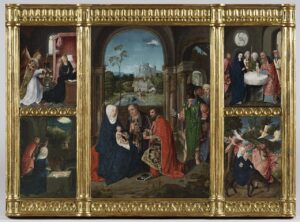
Master of Hoogstraeten, scenes of the infancy of Christ from an altarpiece, c. 1500. Wikimedia Commons.
It’s the second Sunday after Christmas, the eleventh day of Christmas. There aren’t always two Sundays in the Christmas season, of course; it’s only twelve days long. And the Canadian church seems particularly inclined to jump the gun on the season of Epiphany and observe it on the Sunday prior. We’ve done that when the feast of the Epiphany falls on a Monday, so it’s just being moved up by one day, but any more than that and I feel like it does a disservice to Christmas, which is a real season (and yes, merchants of the world, the Twelve Days start on December 25th and nothing you can do will ever change that).
We all know the story, right? The angels, the manger with the ox and donkey, the shepherds and their sheep, and the Magi. It’s a lovely, familiar story that fits nicely into the brief not-quite-two-weeks of the holiday, and is wrapped up with a fancy gold bow and a whiff of incense on Epiphany when the wise men come (which is why we want so badly to celebrate that feast and sing those hymns).
But the second Sunday of Christmas reminds us that there’s much more going on. This is actually very much not a neat and tidy story. Unfortunately, its other elements only appear in our schedule of readings once every three years, on the first Sunday of Christmas. Some of them have their own feast days during the Twelve Days, but let’s face it, those tend to disappear into that blur between Christmas and New Year’s, when we’re not sure what day of the week it is or whether we’ve eaten any vegetables in the past forty-eight hours.
The Gospels of Mark and John don’t talk about Jesus’ childhood at all. The manger, shepherds and angels are from Luke; the Magi (who were not necessarily three, and almost certainly not kings) are from Matthew. In Matthew’s Gospel, the departure of the Magi is followed – now that King Herod has the wind up – by Herod’s campaign of infanticide against the children of Bethlehem, in his attempt to eliminate this potential claimant to the throne. And it is this Massacre of the Holy Innocents – whose feast day is December 28 – that drives Mary, Joseph and their child to seek safety in Egypt.
In Luke, on the other hand, there is no hint that the Holy Family ever went anywhere. They bring Jesus, at forty days old, to the Temple for the traditional rite of redemption of the firstborn, where they encounter the mystic Simeon and the prophetess Anna; and Luke is our only witness to any event in Jesus’ life between his toddlerhood and his baptism at roughly age 30, when he tells the story of Jesus ditching his parents on the way back from Passover in Jerusalem at age twelve, to go sit at the feet of the teachers in the Temple. Given this depiction of Mary and Joseph as devout, observant Jews, one assumes they also had Jesus circumcised on schedule on the eighth day following his birth, which is why the Church has long observed the Feast of the Circumcision – now more tactfully renamed the Feast of the Holy Name – on January 1.
It’s possible to make both these sets of stories fit together in a single timeline, if you assume that Jesus was circumcised in Bethlehem, that the Magi arrived there when he was about five weeks old, and that the dream in which Joseph is told to flee to Egypt took place just after Jesus was presented in the Temple. (I kind of hope it didn’t, though, or poor Mary would be stuck spending weeks on the road to Egypt with a newborn, while still recovering from childbirth!)
But Luke and Matthew are clearly telling two different stories, in thematic terms. Both are about prophecy and its fulfilment; but Luke focuses much more on the women in the story and on Jesus’ origins in a humble, observant Jewish family; Matthew’s version is much darker and more dangerous, with its homicidal king, exiled family, and mysterious travelers from foreign lands.
Meanwhile, the actual readings for today – from the letter to the Ephesians and the gospel of John – see the Incarnation, the event of God coming to live as one of us, very much in cosmic terms. Ephesians speaks of being chosen in Christ before the foundation of the world, destined for adoption as his children, redeemed through his blood, through the mystery of God’s will and plan for the fullness of time. John, meanwhile, in the familiar passage that concludes the Service of Lessons & Carols, describes Jesus as God’s eternal Word, the light that has come into the world, when God became flesh in Jesus Christ. These transcendent concepts seem very far removed from the concerns of a woman trying to cope with her postpartum bleeding while sleeping on hay or riding for weeks into Egypt, or those of a family scraping together the coins to buy two pigeons in order to complete the ritual of dedication of their child.
And yet, as always, we need both. We need the humble details of the Nativity story – in all its messiness – and we need the reminder of the extraordinary, cosmic, transcendent meaning of it all. And in particular, we need the reminder that when God chose to become incarnate, when the immortal Word took flesh, when the Light came into the world, God did not choose to do so by entering the halls of power where Herod ranted and Caesar Augustus called for a census. God chose to become human among people who rode donkeys, and sometimes had to sleep with the livestock, and occasionally lost track of their children while walking home from the Passover feast.
The Power that rules the cosmos rejects the kind of power that humans try to wield on earth. The Word made flesh is made perfect in weakness. The Light that shines in the darkness does so with the smallest of flames. As E. M. Forster wrote: “… one can, at all events, show one’s own little light here, one’s own poor little trembling flame, with the knowledge that it is not the only light that is shining in the darkness, and not the only one which the darkness does not comprehend.”
None of us is too small for what we do, day in, day out, to make a difference. It may not get much attention. It probably won’t be in the way we expect. But if we just keep choosing the good, if we just keep choosing to shine the light, we too are part of the story of the Saviour who was born in the stable, dedicated in the temple, saved from Herod, and who sat at the feet of the teachers. The Saviour who shook up the powers and principalities, terrified kings, and thus made known the truth of God to the world.
Amen.
Leave a Reply