All Saints by the Lake, Dorval
December 7, 2025
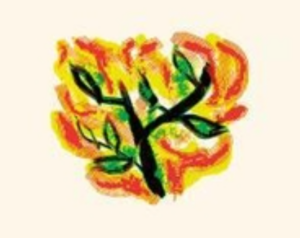
The cover art of Leonard Cohen’s The Flame
The theme of my preaching this year seems to be “things I never noticed before despite reading the Bible regularly for forty years.” This week, it’s the weirdness of John the Baptist being here at all.
Not the weirdness of his clothes, or his diet, or his message – that’s all very familiar. But the weirdness of him being here, in the desert, preaching a baptism of repentance.
Because John is the son of a priest. The story of his miraculous birth to Zechariah and Elizabeth is told in the first chapter of the gospel of Luke – and includes the angel of the Lord appearing to Zechariah while he is offering incense in the sanctuary, to tell him that his wife will conceive a son. Given that both are already elderly at this point, I think we can safely assume that John was their only child. So why isn’t John in the Temple, dutifully serving as the next generation to offer sacrifice before the Lord? What is he doing in the desert, yelling about repentance?
The signs were certainly there from the beginning: the angel told Zechariah that his son would “be great in the sight of the Lord .. even before his birth he will be filled with the Holy Spirit.” And when Zechariah sang his song of praise at John’s birth, he told his child: “You will go before the Lord to prepare his way, to give his people knowledge of salvation”. Did Zechariah realize at the time that this meant that his only son would not follow in his footsteps into the priesthood that was their birthright?
We don’t know by what path John came to his understanding of his calling, whether it was simple or complex, torturous or joyful. (It was probably a little bit of all those things.) But here he is, one who was born to an insider role and a privileged position, having given all that up to go out to the margins of society, wear clothes and eat food that indicate that he is more of a hunter-gatherer than a settled village dweller, and call the people to repentance from the wilderness rather than offering burnt offerings for their sins in the Temple.
And the people can’t get enough. Human beings respond to authenticity, and if there’s one thing you can say about John the Baptist, it’s that he clearly means every word he says. (In just a few months, he will be imprisoned and then beheaded for his refusal to compromise his message.) Even the religious authorities, the Pharisees and Sadducees, come for baptism, and seem relatively unfazed by John calling them a brood of vipers.
The rest of John’s speech is one of those many biblical passages that sounds scary on the surface but is much more complex than it initially appears. The ax is lying at the root of the trees; every tree that doesn’t bear good fruit will be cut down and thrown into the fire. The wheat will be gathered into the granary, but the chaff will be burnt with unquenchable fire.
These phrases have contributed to the image in the popular imagination of eternal hellfire waiting after death for those who commit sins. But that interpretation relies on two large assumptions: one, that the trees and the chaff represent people; and two, that the unquenchable fire is a bad thing.
One of the colleagues in my lectionary discussion group pointed out this week that actually, when an unquenchable fire appears in the Bible, it’s often a good thing, a sign of the presence of God’s Spirit. The Burning Bush, for example, out of which God spoke to Moses, or the tongues of flame that appeared over the heads of the disciples when they spoke in many languages on the day of Pentecost. Fire can illuminate, inspire, and warm, as well as hurt and destroy.
And this pronouncement of John the Baptist’s seems to be much more in line with passages elsewhere in the Bible about metal being refined by fire, than with a straightforward threat of damnation.
Last week we sang a hymn whose fourth verse described the coming Kingdom of God in these words:
That day in whose clear shining light
All wrongs will be revealed:
When justice shall be throned in might,
And every hurt be healed.
God’s light, God’s unquenchable fire, reveals the truth and heals our wounds; it does not torture.
John’s baptism is about repentance – turning around – making a fresh start, changing our behaviour, leaving behind that which weighs us down and deciding to do something different. Clearing the dead brush, burning away the chaff, is a vivid and appropriate image, as is the literal washing in water that happens as part of the baptism ceremony.
And I wonder whether this was an image that resonated particularly for John because of his own history. There must have been some painful renunciations in John’s past, whenever and however he decided that his father’s path of settled, respectable service in the Temple priesthood was not for him. I wonder if it felt, for John, like barren trees being cut down and burned, like the chaff being blown away and set alight, as he made the decision not to spend his life offering burnt sacrifices and incense before the Lord of Hosts in God’s house in Jerusalem. This message speaks much more sympathetically, and is easier for us to hear, if it comes from John’s hard-won personal experience rather than just his free-floating anger.
So perhaps John the Baptist’s invitation is not just about giving up our favourite sins – though it certainly is about that! But perhaps it’s also about the unquenchable fire that burns within us when we know, with unshakeable certainty, what is the path that God is calling us to take. Sometimes you have to let everything else be purged away in order to reveal the central commitment that remains. Sometimes, even if you have a comfortable, secure path ahead of you, God insists on something completely different, and you have to just take a deep breath and go with it, trusting God that what survives the fire is what was intended to last.
It’s Advent. Jesus is coming, to baptize us with the Holy Spirit and with fire. What will survive that cleansing flame? How shall we prepare to meet the one who is to come?
Last month I read a book by Nova Scotia pastor Matthew Anderson on the surprising similarities between the Apostle Paul and Leonard Cohen. But thinking about John the Baptist in this context, I kept coming back to Cohen’s similarities to John as well – as a son of the Temple priestly line who nevertheless felt a clear and overriding calling to do something different, to speak the presence of God into the world as a prophet of both suffering and love, and to do so in the language of flame.
And so perhaps, as we hear John’s strident accusations, and wait for the revelation of the one who is to come, all that needs to be on our lips is the old promise of all those who have been called by God – however reluctantly – in every age:
Hineni, hineni,
I’m ready, my Lord.
Amen.
Leave a Reply